

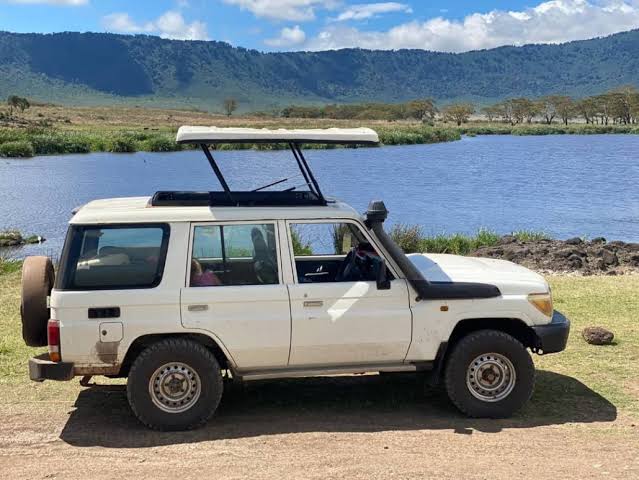
A Roof Tent Car Hire Tanzania package gives adventurous travelers the freedom to explore Tanzania with a fully equipped 4×4, comfortable rooftop sleeping space, and essential camping equipment. Instead of following a fixed lodge-to-lodge safari, you can travel at your own pace, stay at authorized campsites, explore famous wildlife areas, and enjoy one of East Africa’s greatest road-trip destinations.
Tanzania offers extraordinary opportunities for self-drive safari travel. From Arusha, you can explore Tarangire National Park, Lake Manyara, Ngorongoro Conservation Area, Serengeti National Park, Lake Natron, and other spectacular destinations. Longer journeys can connect northern Tanzania with Kenya or continue across East Africa when rental conditions and cross-border documentation allow.
Choosing the right Roof Tent Car Hire Tanzania service requires more than comparing daily rental prices. Safari roads place very different demands on vehicles from ordinary city driving. You need a reliable 4×4, strong tires, adequate ground clearance, spare-wheel equipment, practical camping gear, suitable insurance, clear rental conditions, and dependable assistance if something goes wrong.
A properly prepared Toyota Land Cruiser with a rooftop tent can become your transport, wildlife-viewing vehicle, luggage carrier, kitchen, and mobile sleeping setup. This combination makes roof-tent travel attractive to couples, photographers, independent travelers, overlanders, families, and small groups seeking a more flexible Tanzania safari.
This complete guide explains how to choose a Tanzania roof-tent rental, which 4×4 works best, what camping equipment you need, where you can travel, how to plan Serengeti and Ngorongoro routes, what affects rental prices, and how to organize a safe and memorable Tanzania self-drive safari.
Why Choose Roof Tent Car Hire Tanzania?
A Roof Tent Car Hire Tanzania adventure gives you far more independence than a conventional safari transfer.
You control your route, departure times, photography stops, meal breaks, campsite choices, and the amount of time you spend in each destination.
For experienced self-drive travelers, this freedom forms a major part of the adventure.
You can wake up at a campsite, prepare breakfast, close your rooftop tent, organize your equipment, and begin another safari day without packing and unpacking conventional hotel luggage every morning.
The vehicle becomes the center of the journey.
A rooftop tent also keeps your sleeping space separate from the ground. Most modern systems include a mattress and use a ladder for access.
Travelers should still follow all campsite and wildlife safety instructions because Tanzania’s safari areas remain genuine wildlife environments.
What Is a Tanzania Roof-Tent Safari Vehicle?
A roof-tent safari vehicle combines a capable rental vehicle with a tent mounted above the roof.
During driving, the tent remains folded or closed.
At the campsite, you open the tent, position the ladder, arrange your bedding, and create an elevated sleeping space.
Rental companies may equip vehicles with soft-shell folding tents or hard-shell rooftop tents.
Both systems can work well when properly maintained.
A complete camping setup may also include a mattress, bedding, camping chairs, table, cooking stove, gas equipment, cooking utensils, plates, cups, water containers, refrigerator, lighting, charging equipment, basic tools, jack, spare wheel, and recovery equipment.
Always ask for the exact equipment list before paying.
Best Vehicle for Roof Tent Car Hire Tanzania
A strong 4×4 makes a major difference on a Tanzania road trip.
Many travelers choose a Toyota Land Cruiser because East African safari operators widely use different Land Cruiser models for demanding wildlife routes.
A suitable vehicle should provide good ground clearance, four-wheel-drive capability, enough storage, reliable suspension, appropriate tires, and sufficient carrying capacity for passengers, food, water, luggage, tents, and camping equipment.
The exact model matters less than its condition and suitability for your itinerary.
A beautifully photographed vehicle with worn tires and poor maintenance creates more risk than an older but professionally maintained safari 4×4.
Before accepting the car, inspect it carefully.
Toyota Land Cruiser Roof Tent Rental Tanzania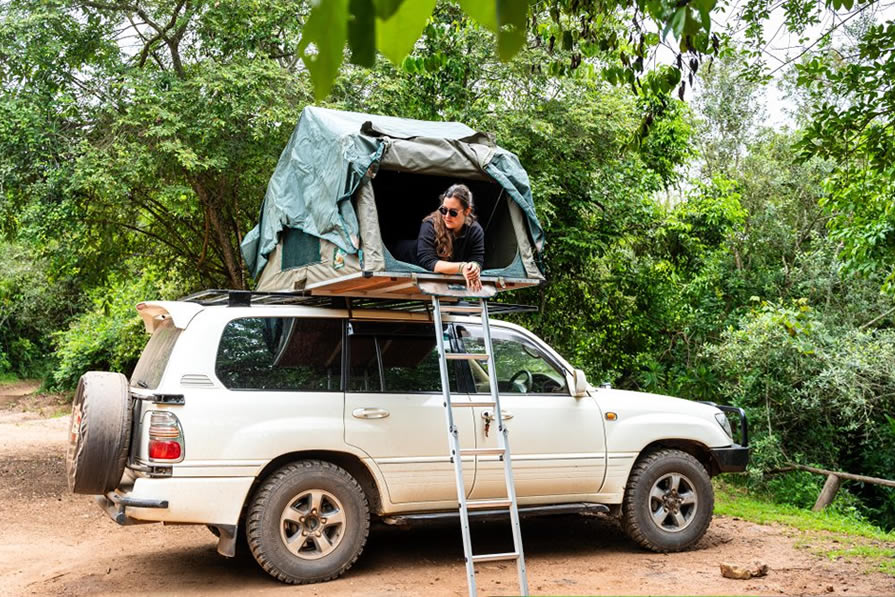
A Toyota Land Cruiser can provide an excellent platform for a self-drive safari.
Land Cruisers combine durability with the ability to handle many rough-road environments when drivers use them correctly.
Couples may need only one rooftop tent.
Families or small groups may require two tents or another sleeping arrangement.
Before booking, ask which exact Land Cruiser model the company provides.
Also confirm passenger capacity, luggage space, fuel type, transmission, roof-tent capacity, refrigerator size, spare-wheel setup, and camping inventory.
Do not rely solely on the phrase “fully equipped Land Cruiser.”
Ask what “fully equipped” actually means.
Land Cruiser Prado Roof Tent Rental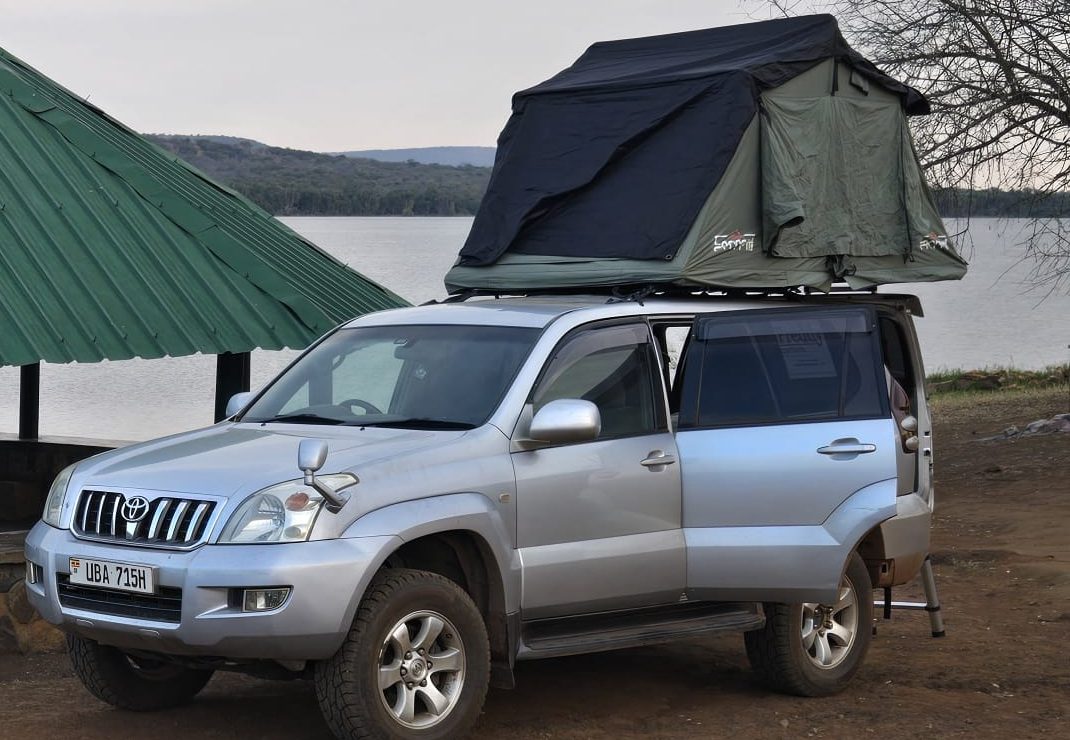
A Toyota Land Cruiser Prado can suit travelers who want comfort on paved roads while retaining four-wheel-drive capability for appropriate safari routes.
Prados can work particularly well for couples and smaller groups.
However, the suitability of a particular vehicle depends on its setup and your intended itinerary.
A vehicle prepared for normal highway rental differs significantly from one prepared for a multi-day Serengeti camping trip.
Tell the rental provider exactly where you plan to travel.
Why a 4×4 Matters in Tanzania
Tanzania contains excellent highways, gravel roads, park tracks, steep sections, dusty roads, corrugations, and routes that change significantly after rain.
A two-wheel-drive city rental may work for ordinary urban transportation, but serious safari routes require more careful vehicle selection.
Four-wheel drive gives the driver additional capability when conditions deteriorate.
It does not make a vehicle unstoppable.
Drivers can still become stuck in deep mud, damage tires, overheat components, or encounter conditions that exceed the vehicle’s limits.
Responsible self-driving means knowing when to continue and when to stop.
Roof Tent Car Hire Tanzania from Arusha
Arusha provides one of the best starting points for Roof Tent Car Hire Tanzania because it serves as the gateway to the northern safari circuit.
Travelers can collect their vehicle in Arusha, purchase groceries and water, inspect the camping equipment, receive a vehicle briefing, and begin their road trip.
From Arusha, Tarangire National Park makes a natural first destination.
Travelers can then continue toward Lake Manyara, the Ngorongoro highlands, Serengeti National Park, and other northern destinations.
Arusha also gives travelers access to vehicle support, supermarkets, fuel stations, accommodation, and other useful services before entering more remote areas.
Roof Tent Car Rental from Kilimanjaro Airport
International travelers frequently arrive through Kilimanjaro International Airport.
Depending on the rental arrangement, the company may organize airport collection, vehicle delivery, or a transfer to Arusha.
After a long international flight, consider spending the first night near Arusha instead of immediately beginning a long self-drive journey.
This gives you time to rest before driving an unfamiliar vehicle.
The following morning, you can inspect the vehicle carefully, buy supplies, learn how the rooftop tent works, and start the safari with better concentration.
Roof Tent Car Rental from Dar es Salaam
Dar es Salaam can serve as a starting point for travelers exploring southern Tanzania or planning a longer overland journey.
The route structure differs significantly from the northern circuit.
Tanzania is a large country, so travelers should avoid underestimating distances.
If your main goal involves Serengeti, Ngorongoro, Tarangire, and Lake Manyara, Arusha generally provides a more practical northern starting point.
Travelers focusing on southern destinations should discuss the intended route with the rental provider before choosing a vehicle.
Roof Tent Car Hire Tanzania for Serengeti Safaris
A Roof Tent Car Hire Tanzania trip becomes particularly exciting when the itinerary includes Serengeti National Park.
The Serengeti ranks among Africa’s most famous wildlife landscapes.
Travelers may encounter lions, elephants, giraffes, buffaloes, cheetahs, leopards, zebras, wildebeest, hyenas, hippos, antelopes, and extraordinary birdlife.
A self-drive safari gives experienced travelers substantial independence, but the Serengeti demands preparation.
Distances can be considerable.
Road conditions vary.
Fuel planning matters.
Navigation requires attention.
Wildlife can appear unexpectedly.
Campsites require appropriate arrangements.
A well-equipped 4×4 gives you the foundation for the trip, but sensible planning creates the experience.
Camping in Serengeti National Park
Camping in or around the Serengeti creates an entirely different feeling from staying in a conventional hotel.
At night, the sounds of the surrounding landscape remind you that you are sleeping inside a major wildlife ecosystem.
This experience can feel extraordinary, but travelers need discipline.
Use authorized campsites.
Follow park and campsite rules.
Store food correctly.
Keep the campsite clean.
Do not approach animals.
Avoid unnecessary movement after dark where local rules or conditions make it unsafe.
A rooftop tent elevates your sleeping space, but it does not remove the need for wildlife awareness.
Great Migration Self-Drive Safari
Many travelers rent roof-tent vehicles because they want to experience the Great Migration.
The migration involves large numbers of wildebeest and zebras moving through the wider Serengeti ecosystem according to seasonal grazing and rainfall.
Their location changes throughout the year.
Travelers should therefore plan the route according to their travel dates rather than assuming the migration always occurs in one section of Serengeti.
A flexible self-drive itinerary can provide advantages because travelers control their daily route.
However, you still need realistic distances, appropriate campsite bookings, and reliable information about current conditions.
Roof Tent Car Hire Tanzania for Ngorongoro
A Roof Tent Car Hire Tanzania itinerary can combine naturally with the Ngorongoro region.
The highlands introduce a different environment from the warmer plains.
Temperatures can become surprisingly cool, particularly at night and early in the morning.
Travelers sleeping in rooftop tents should therefore pack warm layers and confirm that the supplied bedding suits the expected conditions.
The wider Ngorongoro area also requires travelers to follow applicable conservation-area rules and use appropriate camping locations.
Do not assume you can simply park beside any attractive viewpoint and camp.
Tarangire National Park Self-Drive Safari
Tarangire works extremely well within a northern Tanzania road trip.
The park is famous for elephants, baobabs, birdlife, and varied wildlife.
Its location south of Arusha makes it a practical first safari destination.
Travelers can spend one or more nights in the region before continuing toward Lake Manyara and Ngorongoro.
A slower itinerary gives you more time for wildlife viewing and reduces the pressure to drive long distances every day.
Lake Manyara Self-Drive Safari
Lake Manyara adds variety to the northern circuit.
Its ecosystem differs from the open Serengeti plains and Tarangire’s baobab landscapes.
Travelers can incorporate the park between other northern destinations without creating an enormous detour.
When planning a self-drive safari, however, avoid visiting a park simply because its name appears on every standard itinerary.
Your available time should determine how many destinations you include.
Quality usually beats quantity.
Lake Natron 4×4 Adventure
Lake Natron attracts travelers who enjoy remote landscapes and adventurous road trips.
The region can feel dramatically different from Tanzania’s mainstream safari circuit.
Road conditions vary according to route and season.
A suitable 4×4 becomes especially important.
Before including Lake Natron, discuss the route with your vehicle provider and obtain current information.
Do not rely exclusively on an old travel blog because seasonal conditions can change roads significantly.
Tanzania Self-Drive Safari with Rooftop Tent
A self-drive safari places you in control of the journey.
You decide when to start driving.
You manage navigation.
You organize fuel.
You choose where to stop when rules permit.
You set up your campsite.
You prepare meals.
You also accept responsibility for the vehicle.
This independence attracts experienced overlanders, photographers, couples, and travelers who enjoy planning their own adventures.
First-time African safari travelers should think carefully about whether they want this responsibility or would enjoy the trip more with a professional driver-guide.
Roof Tent Car Hire Tanzania with Driver
Not everyone wants to self-drive.
A Roof Tent Car Hire Tanzania package with a driver can combine the atmosphere of camping with the convenience of professional driving.
The driver handles navigation, road conditions, and vehicle operation.
A professional safari driver-guide can also contribute valuable wildlife knowledge.
This allows every traveler to concentrate on landscapes, photography, and wildlife instead of assigning one person to drive.
Driver-guided rental costs more than basic self-drive because the package must account for the driver’s professional services and associated expenses.
Self-Drive vs Safari Vehicle with Driver
Experienced road travelers may prefer self-drive freedom.
First-time Tanzania visitors may prefer a driver-guide.
Neither choice suits everyone.
Self-driving gives you independence and privacy.
Driver-guided travel reduces navigational stress and allows the entire group to concentrate on safari.
Your experience, confidence, itinerary complexity, and budget should guide the decision.
Do not choose self-drive simply because it looks cheaper.
The best safari format is the one you can handle safely and enjoy fully.
Camping Equipment Included with Roof Tent Car Hire Tanzania
A complete Roof Tent Car Hire Tanzania package should clearly state what camping equipment comes with the vehicle.
Common equipment may include a rooftop tent, mattress, bedding, chairs, table, cooking stove, cookware, plates, cups, cutlery, refrigerator or cooler, water containers, lighting, and basic tools.
Equipment varies between companies.
Never assume.
Request a written inventory before confirming the rental.
When collecting the vehicle, check the items against the inventory.
Discovering that an essential piece of cooking equipment is missing after reaching Serengeti creates unnecessary inconvenience.
Rooftop Tent Mattress and Bedding
Sleeping comfort matters more than many first-time renters expect.
After hours of driving and wildlife viewing, a poor mattress can quickly affect the trip.
Ask about mattress dimensions and bedding.
Confirm whether sheets, sleeping bags, blankets, and pillows come with the rental.
Travelers visiting cooler highland areas may need warmer bedding than those camping in lower, hotter regions.
A quality roof-tent safari should provide both adventure and reasonable sleeping comfort.
Camping Kitchen and Cooking Equipment
Cooking becomes part of the road-trip experience.
A practical camping kitchen should make simple meals easy to prepare.
Depending on the vehicle, the rental equipment may include a stove, gas cylinder, pots, pans, utensils, cutting equipment, plates, cups, and washing supplies.
A refrigerator adds significant convenience.
Before departure, test the cooking equipment.
Make sure you understand the gas system.
Never wait until darkness at your first campsite to discover how the stove operates.
Tanzania 4×4 Rental with Refrigerator
A refrigerator can transform a longer camping trip.
It allows travelers to carry fresh food, cold drinks, and other temperature-sensitive supplies more comfortably.
Ask about refrigerator capacity and power source.
A small refrigerator that works well for two travelers may not hold enough food for a family.
Also confirm whether the electrical system can operate the refrigerator without draining the vehicle’s main starting battery.
A properly designed camping setup should separate critical vehicle starting power from auxiliary camping requirements where applicable.
Water Storage for Tanzania Camping Safaris
Carry enough water.
You need water for drinking as well as basic campsite use.
The amount depends on group size, temperature, itinerary, and resupply opportunities.
Ask what water containers come with the vehicle.
Refill before entering remote sections.
Never assume every campsite will sell sufficient bottled water.
Good overland planning means preparing before you need something.
Roof Tent Setup
The rental company should demonstrate how to open and close the rooftop tent.
Then you should do it yourself.
Watching someone perform the setup does not guarantee that you will remember every step.
Practice attaching the ladder, opening the tent, arranging supports, storing bedding, and closing the cover.
A simple practice session at the rental office can save significant frustration later.
The best systems should allow travelers to establish camp relatively quickly once they understand the process.
Roof Tent Car Hire Tanzania for Couples
Couples represent an ideal market for Roof Tent Car Hire Tanzania.
One rooftop tent often provides sufficient sleeping space while the vehicle offers room for luggage, food, water, cameras, and camping equipment.
Couples can also mix accommodation styles.
You might camp for three nights, spend a night at a lodge, camp again, and finish with another comfortable hotel.
This approach provides adventure without requiring you to camp every night of the holiday.
Roof Tent Car Hire Tanzania for Families
Families need more space and more careful planning.
Four passengers plus luggage, water, food, chairs, tables, kitchen equipment, and sleeping gear can quickly fill a vehicle.
Ask about actual storage capacity rather than simply passenger seats.
A family may require two rooftop tents.
Alternatively, the rental company may offer another camping configuration.
Parents should discuss children’s ages, sleeping arrangements, campsite facilities, and driving distances before confirming the itinerary.
Tanzania Roof-Tent Safari for Photographers
Photographers should consider more than sleeping equipment.
The vehicle needs practical wildlife-viewing positions and safe camera storage.
Ask whether the vehicle configuration allows easy photography through windows or another appropriate viewing setup.
Confirm charging options.
Carry sufficient memory cards and batteries.
Protect equipment from dust.
A large telephoto lens needs more storage space than ordinary travel photography equipment, so include camera bags when calculating luggage capacity.
Tanzania Roof-Tent Safari for Solo Travelers
Solo road trips provide extraordinary independence.
They also place every responsibility on one traveler.
You drive, navigate, cook, set up camp, manage the vehicle, and make decisions when conditions change.
Experienced overlanders may enjoy this challenge.
Travelers with limited remote-driving experience should consider whether a driver-guide offers better value.
Solo travelers should also discuss emergency communication and roadside support before departure.
How Much Does Roof Tent Car Hire Tanzania Cost?
The cost of Roof Tent Car Hire Tanzania varies according to travel dates, vehicle model, rental duration, tent configuration, camping equipment, insurance, mileage policy, pickup point, return location, and cross-border requirements.
A fully equipped Land Cruiser will generally cost more than a basic compact rental.
A vehicle with two rooftop tents may cost more than a single-tent setup.
One-way rentals can include relocation charges.
Cross-border travel can create documentation or insurance costs.
Long rentals may qualify for different rates.
The best approach is to request a quotation based on your exact trip.
Cheap Roof Tent Car Hire Tanzania
Travelers frequently search for cheap roof tent car hire Tanzania, but the lowest price should never become the only consideration.
Mechanical reliability matters.
Tire condition matters.
Insurance matters.
Emergency support matters.
Camping equipment matters.
A cheap rental can become extremely expensive if a poorly maintained vehicle breaks down in a remote location.
Compare the complete service rather than the headline daily rate.
Affordable Tanzania 4×4 Rental
Affordable and reliable can work together.
Choose a vehicle appropriate for your group rather than paying for unnecessary capacity.
Travel for enough days to benefit from longer-rental pricing when available.
Use public or suitable authorized campsites where appropriate.
Mix camping with occasional mid-range accommodation.
Plan an efficient route rather than driving enormous unnecessary distances.
Good planning reduces costs without compromising the core safari experience.
Tanzania Roof Tent Rental Price Per Day
Daily rates vary widely, so a single generic number can mislead travelers.
Instead, compare quotations using identical requirements.
Ask each company for the same vehicle category, rental dates, camping equipment, insurance, mileage, pickup location, return location, and route permissions.
Only then can you make a meaningful comparison.
A USD difference in daily rate means little if one quotation excludes important equipment or support.
Insurance for Roof Tent Car Hire Tanzania
Insurance deserves careful attention.
Read the rental agreement.
Understand the excess or deductible.
Ask what damage the policy covers.
Confirm any exclusions involving tires, glass, roof equipment, underbody damage, water damage, unauthorized roads, or negligent driving.
The exact terms vary between companies.
Do not rely on assumptions based on rental experiences in another country.
If something remains unclear, ask before paying.
Mileage Policy
Some rentals may include unlimited mileage while others apply restrictions.
Long safari itineraries can accumulate significant distance.
Calculate your approximate route before comparing rates.
A cheaper rental with strict mileage limits can ultimately cost more than a higher daily rate with a better mileage allowance.
Also confirm whether certain routes require prior authorization.
Vehicle Maintenance
Maintenance should rank near the top of your selection criteria.
Ask how the company prepares vehicles between rentals.
Inspect tires.
Check visible fluid levels if appropriate.
Confirm that lights work.
Check the spare wheel.
Make sure the jack and tools are present.
Listen for unusual warning lights or obvious mechanical issues during the handover.
A reputable provider should welcome reasonable inspection rather than rushing you out of the parking area.
Breakdown Support
Strong support separates a serious safari rental provider from an ordinary car-hire business.
Ask what happens if you experience mechanical trouble.
Who do you call?
Is support available outside office hours?
Can the company coordinate repairs in another town?
What happens if the vehicle cannot continue?
Does the company provide replacement arrangements under applicable circumstances?
Clear answers matter before you enter a remote national park.
Spare Tires and Safari Roads
Tire problems can occur on rough safari roads.
Inspect the main tires before leaving.
Confirm that the spare tire holds proper pressure and matches the vehicle’s requirements.
Know where the wheel-changing tools are located.
Ask the rental representative to demonstrate the jack points if you are unfamiliar with the vehicle.
Preparation turns a manageable tire problem into a minor delay instead of a major crisis.
Fuel Planning
Fill the tank before remote routes.
Do not drive until nearly empty simply because the map shows a fuel station ahead.
Fuel availability can change.
Ask the rental company where travelers normally refuel on your planned itinerary.
Know your vehicle’s approximate fuel consumption and tank capacity.
If the rental setup includes approved additional fuel storage, learn how to use and secure it correctly.
Navigation for Tanzania Self-Drive Safaris
Use reliable navigation and download offline maps.
Mobile internet may become weak in remote areas.
Review your route before leaving each morning.
Do not blindly follow a digital navigation application onto an unsuitable track.
Park signs, official information, local guidance, and current conditions matter.
When uncertain, ask authorized staff rather than taking a road simply because an app displays it.
Driving Distances in Tanzania
Tanzania looks manageable when viewed on a small map, but safari travel takes time.
Gravel roads and wildlife areas reduce average driving speeds.
Game viewing itself also takes time.
Do not design an itinerary that requires racing from one destination to another.
Driving fewer kilometers can produce a better safari because you spend more time observing wildlife and less time staring at the road.
Avoid Unnecessary Night Driving
Plan your route around daylight whenever practical.
Night driving reduces visibility and increases the difficulty of identifying pedestrians, animals, road hazards, and unfamiliar turns.
Protected areas also operate under specific access and driving rules.
Start early enough to reach the intended destination comfortably.
If delays occur, reconsider the plan rather than taking unnecessary risks to maintain a schedule.
Campsites for Roof Tent Car Hire Tanzania
Travelers using Roof Tent Car Hire Tanzania still need appropriate campsites.
You cannot simply park anywhere and sleep.
National parks, conservation areas, private properties, and communities have rules governing camping.
Some locations offer public campsites with shared facilities.
Other safari areas may have special or more remote camping arrangements.
Research the facilities and booking requirements before arrival.
Your rental provider or safari planner can help you understand how campsites fit into the road-trip itinerary.
Public Campsites in Tanzania
Public campsites can provide an affordable and social camping experience.
Facilities vary.
Some provide showers, toilets, cooking areas, or other basic infrastructure.
Others remain much simpler.
Read current campsite information before planning around a particular facility.
Travelers should carry enough essential equipment to remain comfortable even when campsite infrastructure is basic.
Special Campsites
Special campsites may offer a more remote safari atmosphere.
Facilities can be limited, and booking procedures may differ from public camping.
Travelers choosing remote camping need stronger preparation.
Food, water, lighting, wildlife awareness, communication, and campsite discipline become even more important.
Remote does not automatically mean better.
Choose the camping style that matches your experience level.
Wildlife Safety at Campsites
Never forget that safari campsites can sit inside active wildlife environments.
Do not approach animals.
Do not feed them.
Store food correctly.
Follow instructions concerning movement after dark.
Keep children under appropriate supervision.
Use a flashlight when necessary, but do not wander unnecessarily.
Wild animals do not become harmless because they appear near a tent or vehicle.
Respectful behavior protects both travelers and wildlife.
Food on a Tanzania Self-Drive Camping Safari
Buy major supplies before entering remote areas.
Arusha offers convenient opportunities to purchase groceries for northern-circuit journeys.
Choose meals that you can prepare easily.
After eight hours of driving and wildlife viewing, most travelers do not want to spend another two hours cooking a complicated dinner.
Use your refrigerator efficiently.
Store food securely.
Keep the campsite clean and manage waste responsibly.
Electricity and Charging
Ask how the vehicle supplies electrical power.
USB ports work well for phones and small devices.
Photographers may require more substantial charging capability.
Some camping vehicles use auxiliary batteries, inverters, or other power solutions.
Understand the system before departure.
Do not drain the main vehicle battery by running camping equipment incorrectly.
A good vehicle handover should explain both the camping and electrical systems.
Roof Tent Car Hire Tanzania During the Dry Season
Demand for Roof Tent Car Hire Tanzania can increase during popular dry-season safari periods.
Travelers often prefer these months because road conditions can become more manageable and wildlife viewing can be excellent.
The most suitable camping vehicles may sell out earlier than ordinary rental cars.
If your dates are fixed, reserve your preferred 4×4 well ahead.
Vehicle availability deserves the same planning attention as campsites and park arrangements.
Roof Tent Car Hire Tanzania During the Rainy Season
Rain can transform road conditions.
Mud, standing water, slippery tracks, and damaged road surfaces can make some routes more challenging.
A 4×4 helps, but good judgment matters more.
Ask for current road information.
Avoid driving into deep water when you do not know its depth or surface conditions.
Do not follow another vehicle into a difficult section simply because its driver succeeded.
Your vehicle, tires, experience, and load may differ.
Cross-Border Tanzania 4×4 Rental
Some travelers want to use the same vehicle across several East African countries.
This can create an extraordinary overland adventure, but the rental company must approve it.
Vehicle documents, insurance, border requirements, roadside assistance, and rental conditions all become more complicated.
List every country you intend to enter before booking.
Never decide spontaneously to cross an international border with a rental vehicle.
Tanzania to Kenya Roof-Tent Car Hire
A Tanzania and Kenya self-drive safari can connect two of East Africa’s most famous wildlife destinations.
However, cross-border authorization remains essential.
Ask whether the vehicle’s documentation and insurance cover Kenya.
Confirm any cross-border charges.
Discuss where you can return the vehicle.
Also check current immigration and entry requirements for the travelers themselves separately from the vehicle requirements.
Tanzania to Rwanda 4×4 Rental
Travelers planning a larger East African adventure may want to connect Tanzania with Rwanda.
Such a journey can combine Serengeti wildlife with Rwanda’s mountain landscapes, Akagera National Park, Lake Kivu, and gorilla trekking.
The road journey requires enough time.
You also need explicit cross-border vehicle permission.
One-way rental arrangements can sometimes make a long regional itinerary more efficient if available.
Tanzania to Uganda Roof-Tent Rental
Uganda can also form part of an extended overland safari.
Travelers can combine Tanzania’s savannah destinations with Uganda’s wildlife and primate regions.
Again, the rental agreement must allow the route.
Discuss border paperwork, insurance, emergency assistance, and vehicle return arrangements before departure.
Cross-border travel rewards careful planning.
One-Way 4×4 Rental Tanzania
One-way rental can save time on long journeys.
Instead of returning to the original collection point, you leave the vehicle at another agreed location.
The company may charge a relocation fee.
Compare that fee with the time, fuel, accommodation, and park-route costs required to drive back.
For some itineraries, one-way rental can provide excellent value.
7-Day Tanzania Roof-Tent Safari
Seven days work best with a focused route.
Travelers starting in Arusha can combine selected northern destinations such as Tarangire, Ngorongoro, and Serengeti.
Avoid trying to include every park.
Allow enough time for game drives, campsite setup, meals, and reasonable driving.
A self-drive safari should feel adventurous, not rushed.
10-Day Tanzania Roof-Tent Safari
Ten days give travelers more freedom.
A route can include Tarangire, Lake Manyara or nearby areas, Ngorongoro, and several nights in Serengeti.
The additional time creates space for photography and slower wildlife viewing.
It also reduces the temptation to drive excessive distances.
For many first-time self-drive travelers, approximately ten days can create a strong balance between adventure and manageable logistics.
14-Day Tanzania Self-Drive Safari
Two weeks allows travelers to experience the country at a much more comfortable pace.
You can spend several nights in major wildlife areas, include more remote destinations, and alternate camping with lodge accommodation.
A longer rental also makes the roof-tent setup more worthwhile because you use the vehicle as a complete travel system rather than simply transportation between two hotels.
Combining Roof-Tent Camping with Safari Lodges
You do not need to choose between camping and lodges for the entire holiday.
A mixed itinerary often works extremely well.
Camp for several nights in wildlife areas.
Then book a lodge where you can enjoy a long shower, restaurant meal, laundry service, and a comfortable room.
Return to camping afterward if desired.
This combination can make a two-week road trip more comfortable without removing the sense of adventure.
Tanzania Safari and Zanzibar
Many travelers finish a self-drive safari with several nights in Zanzibar.
In most cases, the simplest strategy is to return the 4×4 at the agreed mainland location and fly to Zanzibar.
Keeping an expensive safari vehicle while spending several days on a beach often provides little value.
Discuss the vehicle return point before booking flights so the road trip connects smoothly with the beach extension.
How to Find the Best Roof Tent Car Hire Tanzania Service
The best provider should offer a reliable vehicle, transparent rental conditions, useful camping equipment, strong customer support, and clear communication.
Look beyond photographs.
Ask detailed questions.
Compare complete quotations.
Read the rental agreement.
Discuss your itinerary.
Make sure the company knows you intend to visit national parks.
Confirm cross-border travel where relevant.
The right provider should help you understand the vehicle rather than simply pressure you to pay.
Questions to Ask Before Booking
Ask which exact vehicle you will receive.
Confirm four-wheel drive.
Ask about transmission.
Check rooftop-tent capacity.
Request the camping inventory.
Ask about insurance and excess.
Confirm mileage conditions.
Ask about spare tires.
Understand breakdown support.
Confirm pickup and drop-off charges.
Provide your planned route.
Ask about prohibited roads or areas.
If you intend to cross borders, request explicit authorization.
These questions can prevent most major misunderstandings.
Why the Cheapest Rental May Not Be the Best Deal
Daily price represents only one part of the total value.
Imagine one company charges less but provides old tires, limited mileage, minimal camping gear, and weak roadside support.
Another charges slightly more but provides strong tires, complete camping equipment, clear insurance, a refrigerator, suitable mileage, and reliable support.
The second option may offer far better value.
A safari vehicle acts as your transport and accommodation.
Reliability deserves priority.
Best Roof-Tent Car Hire Company in Tanzania
Travelers searching for the best roof-tent car hire company in Tanzania should focus on the complete service rather than a company label alone.
The right company for a seven-day Arusha and Serengeti trip may differ from the right provider for a month-long cross-border expedition.
Your ideal provider needs the right vehicle for your route.
It should also provide clear rental terms, adequate insurance, good camping equipment, and dependable support.
The best choice therefore comes from matching the rental service to your actual journey.
Why Book a Customized Tanzania Safari Vehicle?
Every road trip has different requirements.
Two travelers need less sleeping and storage capacity than a family of five.
Photographers require more charging and equipment space.
Cross-border travelers need different paperwork.
A driver-guided safari requires another operational setup.
Long-term rentals need stronger consideration of maintenance, mileage, and support.
Customization prevents you from paying for unnecessary equipment while ensuring the vehicle carries what your itinerary actually requires.
Frequently Asked Questions About Roof Tent Car Hire Tanzania
Can I rent a 4×4 with a rooftop tent in Tanzania?
Yes. Travelers can arrange properly equipped 4×4 vehicles for camping and self-drive safari travel.
What is the best vehicle for a Tanzania roof-tent safari?
A properly maintained Toyota Land Cruiser or another suitable 4×4 can work well, depending on the route, group size, and rental conditions.
Can I rent a roof-tent vehicle in Arusha?
Yes. Arusha is a major starting point for northern Tanzania self-drive safaris.
Can I drive to Serengeti myself?
Self-drive travel is possible subject to applicable park requirements, road conditions, vehicle suitability, and rental permissions.
Can I camp in Serengeti?
Authorized camping options exist. Travelers must follow current park procedures and use appropriate campsites.
Does a roof-tent rental include camping equipment?
It depends on the package. Request an exact inventory before booking.
Can I hire a Land Cruiser with a roof tent?
Yes, depending on vehicle availability and rental company fleet.
Can I rent a roof-tent car with a driver?
Some safari vehicle arrangements include professional driver-guides. Ask for this option when requesting a quotation.
How much does roof-tent car rental cost?
Rates vary according to vehicle, season, duration, camping equipment, insurance, mileage, pickup point, and route.
Can I cross from Tanzania into Kenya?
Only when the rental company authorizes cross-border travel and provides the required vehicle documentation and insurance arrangements.
Can I drive a Tanzania rental vehicle to Rwanda?
Potentially, depending on the rental agreement and cross-border permissions. Confirm before booking.
Is a rooftop tent good for couples?
Yes. A single rooftop-tent vehicle can provide a practical camping setup for two travelers.
Can families use rooftop tents?
Yes, but larger families may require multiple tents or another sleeping configuration.
Do I need a refrigerator?
It is not essential for every trip, but a refrigerator makes longer camping safaris significantly more convenient.
Should I choose self-drive or a driver-guide?
Choose according to your driving experience, itinerary, confidence, budget, and preferred level of independence.
Plan Your Roof Tent Car Hire Tanzania Adventure
A Roof Tent Car Hire Tanzania adventure can turn an ordinary safari into a genuine East African road trip.
You can travel from Arusha toward Tarangire, explore the Ngorongoro highlands, drive through Serengeti landscapes, camp under African skies, and build the journey around your own schedule.
The vehicle matters enormously.
Choose a reliable 4×4 rather than simply the cheapest rental.
Check tires, camping equipment, insurance, mileage, support, and the exact roof-tent configuration.
If your itinerary includes Kenya, Rwanda, Uganda, or another country, arrange cross-border authorization before departure.
Travelers who prefer not to self-drive can also explore driver-guided safari vehicle options.
Universal Ventures Rwanda can assist with customized East African safari planning, safari transportation, regional overland journeys, and routes connecting Tanzania with Rwanda, Uganda, Kenya, and other destinations.
Provide your travel dates, number of travelers, preferred vehicle, pickup location, drop-off location, itinerary, and whether you prefer self-drive or a professional driver-guide when requesting your customized arrangement.
Contact Universal Ventures Rwanda
Universal Ventures Rwanda
Location: Kigali, Rwanda
Email: info@universalventuresrwanda.com
Phone / WhatsApp: +250 781 441 853
