

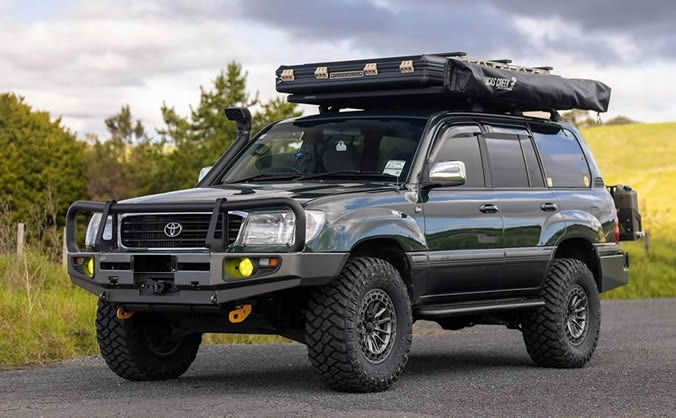
Kenya Safari SUV Rental is one of the most important parts of planning a wildlife holiday in Kenya. Your vehicle does much more than move you from Nairobi to a national park. During a safari, it can become your viewing platform, photography base, luggage carrier, shelter from dust and rain, and the place where you spend many hours each day.
Kenya offers a huge mix of landscapes. Smooth highways connect major towns, yet wildlife areas can have gravel tracks, dust, mud, deep ruts and rough surfaces. A vehicle that feels perfect in Nairobi may not be suitable for several days inside the Maasai Mara or on a long road journey through Tsavo.
Choosing well therefore matters.
Some travelers need a rugged Toyota Land Cruiser with a pop-up roof. Others may be perfectly comfortable in a Toyota Prado. A smaller SUV can work for easier routes, while rooftop-tent vehicles suit travelers who want to camp.
Group size matters too. So do luggage, season, road conditions, photography equipment and the amount of time spent on game drives.
This complete guide explains how SUV rental for Kenya wildlife tours works, which 4×4 vehicles suit different trips, what rentals may cost, when self-drive makes sense, why a driver-guide can be useful, and how to prepare for destinations such as the Maasai Mara, Amboseli, Tsavo, Samburu, Lake Nakuru and Nairobi National Park.
Why Kenya Safari SUV Rental Needs Careful Planning
Safari driving differs greatly from ordinary car rental.
City visitors usually look for comfort, air conditioning and easy parking. Safari travelers need to think about ground clearance, tyres, suspension, luggage room and wildlife visibility.
Road conditions can also change within a few hours.
You might leave Nairobi on good tarmac in the morning. Later, the route may change to gravel. Once inside a park, the surface can become dusty, uneven or muddy.
Rain makes an even bigger difference.
A track that is firm in the dry season can become difficult after a heavy downpour. Deep ruts, slippery soil and standing water may appear quickly.
For that reason, the lowest rental price should not be the main factor.
A suitable Kenya safari car should match the hardest part of your route.
Paying less for the wrong vehicle often creates poor value. You may lose time, struggle with luggage or limit where you can safely travel.
A well-chosen SUV, by contrast, makes the journey feel easy.
Kenya Safari SUV Rental Versus Normal Car Hire
Not every SUV is a safari vehicle.
That point is important because online rental sites often group very different models under the same category.
A compact crossover may offer comfortable seating and all-wheel drive. It could be excellent for Nairobi, Naivasha and other easy road trips.
A customized safari Land Cruiser is built for another purpose.
It may have stronger suspension, greater ground clearance, all-terrain tyres, low-range four-wheel drive and a roof designed for wildlife viewing.
The difference becomes obvious inside a national park.
A normal SUV usually requires passengers to watch animals through side windows. With a pop-up roof, several people can stand safely inside the vehicle and gain a much wider view.
Photography becomes easier as well.
Before booking, look beyond the word “SUV.” Find out what type of vehicle is actually being offered.
What Makes a Good Safari Vehicle?
Several features matter more than luxury branding.
Ground clearance is important because safari tracks are not always level. Strong tyres reduce the risk of trouble on gravel and rocky roads. Reliable suspension makes long drives more comfortable.
Four-wheel drive gives extra traction when surfaces become difficult.
Good visibility matters just as much.
Passengers who spend six hours watching wildlife should have easy access to windows or a pop-up roof. A large SUV with poor viewing positions can be less useful than a simpler purpose-built safari vehicle.
Luggage storage also deserves attention.
Seven seats do not automatically mean seven travelers plus seven large suitcases will fit comfortably.
The best vehicle combines road ability, viewing quality and practical space.
Kenya Safari SUV Rental With a Toyota Land Cruiser
For wildlife-focused travel, the Toyota Land Cruiser remains one of the most common choices in Kenya.
Its reputation comes from strength, high ground clearance and proven four-wheel-drive ability. Safari companies also know the vehicle well, which makes maintenance easier.
Purpose-built safari versions add features that standard road SUVs do not have.
Many include raised roofs, pop-up hatches, individual passenger windows, stronger suspension, cooler boxes and power points for cameras.
Current Kenya rental companies advertise seven-seat customized Land Cruisers with driver-guides for roughly US$175–200 per day in some packages, while rates vary according to fuel, route and included services.
Another self-drive operator currently lists safari-ready Land Cruisers with pop-up roofs around US$180 per day.
Those rates are examples, not fixed prices across Kenya.
Always compare what is included.
Standard Land Cruiser Versus Safari Land Cruiser
Travelers sometimes assume every Land Cruiser is ideal for game drives.
That is not true.
A luxury Land Cruiser V8 can be excellent on rough roads. It offers comfort, power and 4×4 ability. Yet it may still have a normal fixed roof.
Kodinga Logistics, for example, currently states that its Land Cruiser V8 is a standard SUV without a pop-up roof and that specialist safari vehicles are arranged separately.
This distinction matters.
For airport transfers and long road journeys, a standard Land Cruiser can be excellent.
When most of your holiday is spent watching wildlife, a purpose-built version usually offers better views.
Think about how you will use the vehicle rather than buying the most impressive badge.
Kenya Safari SUV Rental With a Toyota Prado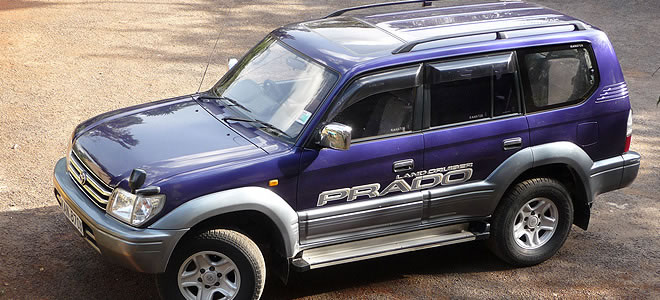
A Toyota Prado can be one of the best choices for smaller groups.
It offers a strong mix of road comfort, 4×4 ability and manageable size.
Couples often find it especially useful. Families of three or four can also travel comfortably if they do not carry too much luggage.
Highway driving generally feels smoother than in some older safari conversions.
The main compromise is wildlife viewing.
Most standard Prados do not have the large pop-up roof found on dedicated safari vehicles.
That may not matter when your lodge provides its own game drives.
Imagine spending three nights at a camp where all wildlife drives are included. Your rental vehicle mainly gets you from Nairobi to the property.
In that case, paying more for a specialist safari Land Cruiser may be unnecessary.
A Prado could offer better overall value.
Compact SUVs for Kenya Wildlife Tours
Smaller SUVs can reduce both rental cost and fuel use.
Models such as the Toyota RAV4 or Nissan X-Trail appear in many Kenya rental fleets. Self Drive Kenya currently lists both compact options and larger Land Cruisers for different travel styles.
Compact vehicles can make sense for travelers following easier routes.
They are also easier to handle in towns and parking areas.
However, AWD and genuine off-road 4WD are not always the same thing.
Some crossover systems are designed mainly to improve road grip rather than handle deep mud or heavily rutted safari tracks.
Ground clearance is usually lower too.
If your itinerary includes difficult roads during the rainy season, paying for a stronger vehicle gives you more margin.
Safari Vans as an Affordable Alternative
A safari van can be a smart option for travelers watching their budget.
Many are fitted with raised or pop-up roofs, so wildlife visibility can still be good.
Groups also benefit from the extra seating.
The main weakness is rough-road performance.
A safari van may handle established dry-season routes without problems, but it usually cannot match a Land Cruiser when tracks become badly muddy or deeply rutted.
Your travel month should therefore influence the decision.
Families visiting popular parks during dry weather may find a van offers excellent value.
Travelers heading into more difficult areas or visiting during heavy rains may prefer genuine 4WD.
Kenya Safari SUV Rental With a Pop-Up Roof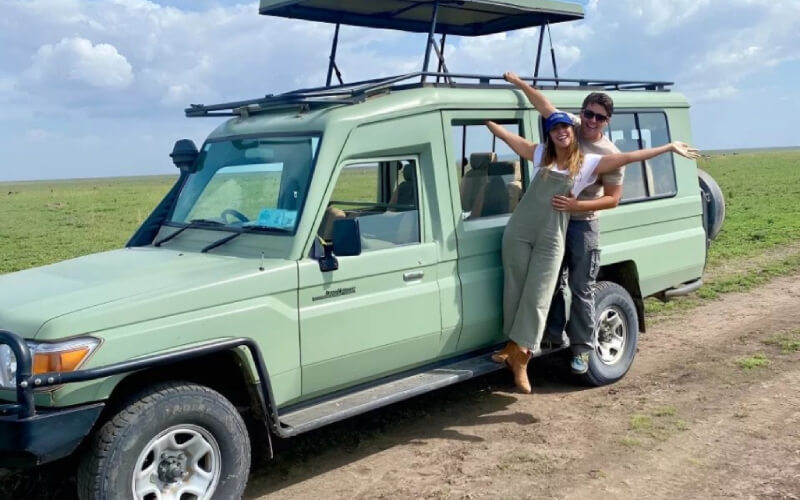
For serious game viewing, a pop-up roof is one of the most useful safari features.
Standing inside the vehicle raises your viewing angle.
Tall grass blocks less of the scene. Distant animals become easier to spot, and several passengers can watch at once.
Photographers benefit as well.
A lion resting behind grass may be difficult to photograph through a low side window. An elevated position often produces a much cleaner view.
Several current rental companies highlight pop-up roofs as a major feature of their specialist Land Cruisers.
The roof normally stays closed during normal road travel.
Once you enter a wildlife area, your guide can open it where permitted.
That simple change turns the SUV into a proper game-viewing vehicle.
Why Window Seats Matter
Seat numbers can be misleading.
A seven-seat vehicle may physically carry seven passengers, yet that does not mean seven adults will enjoy equal wildlife views.
Window access becomes important during game drives.
Animals can appear on either side without warning. A passenger trapped in the middle must lean across someone else each time.
Photography groups feel this problem even more.
Four photographers inside a seven-seat Land Cruiser may have a much better experience than seven photographers packed into the same space.
Extra room allows camera bags to remain accessible while passengers change position easily.
Comfortable capacity is therefore more important than maximum capacity.
Kenya Safari SUV Rental for Photography Tours
Wildlife photographers should choose a vehicle differently from normal tourists.
Camera gear requires space.
A photographer may carry two bodies, several lenses, batteries, beanbags and backup storage. Long lenses are difficult to manage in a crowded vehicle.
Power access also matters during long trips.
Some safari rentals advertise charging ports or power inverters specifically for photographic equipment.
Roof design should be another priority.
Wide openings make it easier to photograph animals in different directions.
Side windows remain useful for low angles.
A smaller group often provides the biggest improvement.
Instead of filling every passenger seat, photographers may prefer fewer people per SUV.
The higher vehicle cost per person can be worth it when photography is the main reason for visiting Kenya.
Kenya Safari SUV Rental for Families
Family travel requires more space than many people expect.
Four seats may sound enough for two parents and two children. Then luggage, snacks, daypacks, jackets, binoculars and cameras are added.
Suddenly the vehicle feels much smaller.
Soft-sided luggage makes packing easier than large hard-shell suitcases.
Parents should also think about travel time.
An SUV may comfortably cover a long distance, but young children may not enjoy spending eight straight hours inside it.
Good family safaris use shorter road days where possible.
A Prado can work very well for a smaller family.
Larger families may prefer a safari Land Cruiser or van.
Whichever vehicle you choose, focus on usable room rather than the number shown on the seat specification.
Kenya Safari SUV Rental for Couples
Couples have much more flexibility.
Nearly every SUV class can provide enough passenger room for two people.
Your choice therefore depends on route, comfort and budget.
A compact 4×4 may be enough for an easier journey.
Prados provide extra comfort for longer road trips.
A full safari Land Cruiser can feel luxurious even when only two travelers are inside.
There is plenty of room for cameras and day bags. Both passengers can move between viewing sides when wildlife changes position.
Honeymooners who value privacy often enjoy having a complete safari vehicle to themselves.
Although it costs more than joining a group departure, the freedom can improve the overall experience.
Kenya Safari SUV Rental for Small Groups
Groups need to think carefully about the balance between price and space.
One large vehicle is usually cheaper than two.
However, two SUVs provide flexibility.
Some travelers may want to spend an hour watching cheetahs while others would rather look for elephants. Separate vehicles make that possible.
Photography is another factor.
Too many people inside one Land Cruiser can turn every sighting into a battle for the best angle.
Groups should therefore consider what matters more: keeping costs down or maximizing viewing comfort.
Neither choice is wrong.
The mistake is booking based only on seating capacity without discussing how the safari will actually feel.
Self-Drive Kenya Safari SUV Rental
Self-drive travel offers something a guided safari cannot fully match: independence.
You choose when to leave.
Stops happen when you want them.
Plans can change during the journey.
Many travelers enjoy the feeling of exploring Kenya at their own pace.
Current operators offer Land Cruisers, Prados, RAV4s, rooftop-tent vehicles and other 4×4 models specifically for self-drive trips.
Freedom comes with responsibility, though.
Navigation is your job.
Fuel planning is yours too.
Someone must watch the road during game drives instead of concentrating fully on wildlife.
You also need to understand the rental agreement, park rules and support procedures.
Experienced road travelers often enjoy that responsibility.
First-time safari visitors may prefer a guide.
Kenya Safari SUV Rental With a Driver-Guide
A professional driver-guide can add much more than driving.
Local guides understand road conditions, park gates, lodge access and practical timing.
Wildlife knowledge adds another layer.
Experienced safari guides watch tracks, birds and animal behavior. They may recognize signs that visitors would never notice.
With someone else driving, every traveler can focus on the landscape.
Photographers can prepare equipment while approaching a sighting.
Families avoid having one parent spend most of the holiday behind the wheel.
Current Kenya suppliers commonly offer customized Land Cruisers with trained or certified driver-guides.
For a first Kenya safari, this can provide excellent value.
Is Self-Drive or Driver-Guided Better?
The answer depends on your goal.
Road-trip lovers may enjoy self-drive more because the journey itself is part of the adventure.
Travelers focused almost entirely on wildlife may get more value from a guide.
Time matters too.
Someone spending ten days in Kenya can afford a few wrong turns or slower wildlife searching.
A visitor with only three safari days may want local expertise from the first morning.
Budget plays a role as well.
Self-drive can reduce driver expenses, although fuel and other costs still need to be considered.
Instead of asking which method is generally better, decide which experience suits your travel style.
Kenya Safari SUV Rental From Nairobi
Nairobi is the main starting point for most Kenya road safaris.
The city provides easy access to several major wildlife circuits.
Heading west takes you toward Naivasha, Lake Nakuru and the Maasai Mara.
Southern routes connect with Amboseli.
Travel southeast and you can reach Tsavo before continuing toward the coast.
Northern journeys lead toward Mount Kenya, Laikipia and Samburu.
Nairobi also has a national park on its doorstep.
That makes the city an excellent base for short and long safari plans.
Rental choice is wider here than in most smaller towns.
Travelers can arrange airport delivery, hotel pickup or collection from the rental company’s office.
Collecting an SUV at Nairobi Airport
Jomo Kenyatta International Airport is a convenient pickup point, but collecting immediately is not always the best idea.
Long international flights cause fatigue.
Driving unfamiliar roads while tired is rarely a strong start to a holiday.
Spending your first night in Nairobi gives you time to rest.
Vehicle inspection can then happen in daylight the following morning.
Scratches are easier to see. Tyres can be checked properly, and equipment is easier to test.
Travelers hiring a driver-guide have less reason to worry about this.
The guide can meet them at the airport and handle the road journey.
Flight arrival time should therefore influence how the rental begins.
Inspecting Your Kenya Safari SUV Rental
A careful handover takes only a short time.
Start by walking around the SUV.
Photograph existing body damage.
Look closely at tyre tread and visible sidewall condition.
Check the spare wheel.
Confirm that the jack and wheel-changing tools are present.
Next, test the lights and air conditioning.
Try every window that matters for game viewing.
Open the pop-up roof if the vehicle has one.
Charging sockets should be tested before you depend on them for cameras.
Drivers using a 4×4 should also understand the controls.
Low-range systems differ between vehicles.
A simple demonstration in Nairobi is much easier than learning beside a muddy track.
Why Tyres Matter So Much
Safari travelers often focus on vehicle models while ignoring tyres.
That can be a mistake.
A well-maintained Prado with strong tyres may provide more confidence than a poorly prepared Land Cruiser.
Look for healthy tread depth.
Cracks or major sidewall damage deserve attention.
The spare should be ready for actual use, not simply attached to the vehicle for appearance.
Some remote safari vehicles carry two spares.
That level of backup may not be needed on every route, but it becomes useful in more isolated areas.
A rental company that takes tyre preparation seriously is usually showing good operational discipline.
Ground Clearance on Kenya Safari Roads
Ground clearance helps an SUV pass over ruts, stones and uneven surfaces without scraping the underside.
Higher is generally better for rough routes.
Still, clearance is only one part of the picture.
Wheelbase, suspension and tyre size also matter.
Driver skill matters even more.
A capable 4×4 can still be damaged by poor decisions.
Travelers should never treat high ground clearance as permission to attack rough roads at speed.
Slow, controlled driving protects both passengers and the vehicle.
Inside wildlife areas, reduced speed also improves animal spotting.
Four-Wheel Drive and All-Wheel Drive
These terms are sometimes used as though they mean exactly the same thing.
They do not.
Many modern AWD systems automatically move power between wheels when grip changes.
That setup works very well for normal roads and moderate dirt tracks.
Traditional 4WD systems may include selectable high and low ranges. Low range is useful when moving slowly through more difficult terrain.
A heavy-duty Land Cruiser often provides this type of ability.
Not every traveler needs it.
Your vehicle only needs enough capability for the most demanding route on the itinerary.
Buying far more capability than needed raises costs without always improving the holiday.
Kenya Safari SUV Rental for the Maasai Mara
The Maasai Mara is one of the strongest reasons to choose your vehicle carefully.
Game drives can last several hours.
Wildlife is often spread across wide grasslands.
A raised roof makes spotting animals easier.
Road conditions change through the year.
Dry periods can bring heavy dust and corrugation. Rain can turn softer soil into difficult mud.
A proper 4×4 Land Cruiser provides valuable confidence when conditions worsen.
For travelers staying at lodges that supply all game drives, the rental situation is different.
Your SUV may only need to reach the property.
A Prado could then be enough.
Before spending extra money, confirm exactly how game drives are handled at your accommodation.
Choosing a Land Cruiser for the Maasai Mara
Dedicated safari Land Cruisers make sense when you plan to conduct most game drives in your rental vehicle.
Pop-up roofs improve visibility.
Strong suspension helps during long hours on rough tracks.
Extra room supports photography and day bags.
Diesel engines are common in safari fleets because they provide strong torque and practical range.
During high-demand migration months, good vehicles can book out early.
Accommodation demand rises at the same time.
Travelers with fixed dates should therefore secure transport once the main itinerary is confirmed.
Waiting until the final weeks may leave fewer suitable choices.
Kenya Safari SUV Rental for Amboseli
Amboseli is well known for elephants and views toward Mount Kilimanjaro when the mountain is clear.
Road access from Nairobi makes it a popular short safari destination.
A high-clearance SUV is a sensible choice.
Travelers visiting during wet conditions gain extra confidence from proper 4WD.
Photographers will also appreciate a pop-up roof because Amboseli’s open landscapes reward elevated viewing.
Current Kenya Wildlife Service fees place Amboseli in its premium-park category. The present non-resident adult conservation fee is US$90 per day under the current schedule.
Park fees should be budgeted separately unless your tour package says they are included.
Vehicle fees and driver charges may also vary by arrangement.
Kenya Safari SUV Rental for Lake Nakuru
Lake Nakuru fits naturally into a Rift Valley road safari.
The park is famous for birdlife and rhino viewing.
Road conditions are often less demanding than the hardest parts of the Maasai Mara, although weather still matters.
A Prado or similar high-clearance 4×4 can therefore be an excellent choice.
If the same vehicle will continue toward the Mara, choose according to the more difficult destination.
Lake Nakuru currently falls within KWS’s premium category, and the current non-resident adult rate is US$90.
Official park guidance also sets a 40 km/h maximum speed, requires visitors to stay on established roads and bans off-road driving.
Those rules matter whether you self-drive or travel with a guide.
Kenya Safari SUV Rental for Tsavo
Tsavo East and Tsavo West cover enormous landscapes.
Distance becomes a major factor here.
A reliable vehicle matters more than luxury styling.
Fuel range should be understood before exploring long routes.
Tyres deserve particular attention as well.
High clearance and proper 4WD provide additional confidence when venturing beyond simple lodge transfers.
Tsavo can also fit beautifully into a Nairobi-to-coast journey.
Travelers may combine Amboseli, Tsavo and then continue toward Mombasa or Diani.
Current KWS conservation fees list Tsavo East and Tsavo West as wilderness parks, with a non-resident adult fee of US$80 under the present structure.
Kenya Safari SUV Rental for Samburu
Northern Kenya feels different from the Mara and Amboseli.
The landscape becomes drier and more rugged.
Road journeys are longer.
Reliability therefore becomes a bigger concern.
A good Land Cruiser or Prado works well for many Samburu trips.
Travelers continuing through Laikipia or farther north should pay more attention to roadside support and spare tyres.
Before departure, confirm what happens if the vehicle develops a major fault far from Nairobi.
Some companies advertise nationwide or 24-hour assistance.
The useful question is not whether assistance exists.
Find out how it works in remote regions and how long replacement support could realistically take.
Kenya Safari SUV Rental for Nairobi National Park
Nairobi National Park is ideal for visitors with little time.
Wildlife viewing can begin very close to the capital.
For a single morning or day, renting a safari Land Cruiser with a driver may make more sense than arranging a long self-drive contract.
Visitors gain a pop-up viewing roof and local knowledge immediately.
Self-drive travelers beginning a longer holiday can also use the park as a simple first safari day.
Kenya Wildlife Service currently states that Nairobi National Park gates open at 6:00 a.m. and close at 6:00 p.m. for non-overnight visitors. The park also applies a 40 km/h speed limit, requires vehicles to stay on established roads and asks visitors to maintain a safe distance from wildlife.
Lake Naivasha and Hell’s Gate by SUV
Naivasha is easy to combine with Nairobi.
Its location makes it a convenient first stop on a longer Rift Valley route.
Travelers staying only around Naivasha may not need a large expedition-style Land Cruiser.
A smaller SUV can provide enough capability while using less fuel.
Hell’s Gate lies nearby and has clear official driving rules.
KWS currently requires vehicles to remain on established roads and follow a 40 km/h speed limit there.
Anyone continuing onward to Lake Nakuru and the Maasai Mara should choose the SUV based on the whole journey.
Switching cars midway usually adds unnecessary work.
Kenya Safari SUV Rental Prices in 2026
There is no single standard price.
Vehicle type is only the beginning.
Self-drive versus driver-guided hire creates a major difference.
Fuel may or may not be included.
Mileage rules affect the final cost.
Camping gear, airport delivery, insurance level and cross-border paperwork can add more.
Current market listings show specialist Land Cruisers around US$175–200 per day with a driver in some packages.
Jaetravel currently lists a pop-up-roof Land Cruiser around US$180 per day.
Another self-drive provider advertises various safari vehicles from about US$100 upward, with larger or driver-equipped Land Cruisers costing more.
Rates should always be confirmed for your specific dates.
Understanding the Daily Rental Price
A daily price alone tells you very little.
Consider two offers.
One company charges US$150 per day.
Another asks US$220.
The first looks cheaper until you discover that fuel, mileage beyond a limit and driver costs are extra.
Perhaps the second includes all three.
The supposedly expensive offer may then provide better value.
A proper quotation should explain what comes with the rate.
Vehicle hire, insurance, mileage, fuel, guide costs, airport delivery and taxes should be clear.
For chauffeur-driven safaris, driver meals and accommodation also need to be understood.
Transparent pricing prevents surprises halfway through the trip.
Fuel Costs
Most self-drive arrangements require travelers to pay for fuel.
Guided safari packages vary.
Some include fuel while others charge it separately.
Vehicle size affects consumption significantly.
A heavy Land Cruiser will normally use more fuel than a compact crossover.
Road conditions make a difference too.
Slow four-wheel-drive work, long game drives and rooftop equipment can raise consumption.
Instead of estimating fuel only from the road distance shown on Google Maps, allow for daily driving inside wildlife areas.
A 200-kilometre transfer is not the only distance covered that day.
Game drives can add many more kilometres.
Mileage Limits
Mileage rules deserve attention on long trips.
Unlimited mileage provides peace of mind.
Several current Kenya companies promote this feature.
Other rental agreements may include a daily allowance.
Once that limit is exceeded, each additional kilometre costs extra.
Long safari routes can build mileage quickly.
Calculate your approximate journey before comparing prices.
Remember to include game drives, airport pickups and small local journeys.
A lower day rate with strict mileage limits may become expensive once the final distance is counted.
Insurance for Kenya Safari SUV Rental
Never treat insurance as a minor detail.
Safari roads expose vehicles to different risks from city driving.
Tyres can be damaged.
Windscreens can be hit by stones.
Rough surfaces increase the chance of underbody damage.
Rental contracts may exclude some of those items.
Find out whether the insurance has an excess.
Learn how much you would pay after damage.
Coverage for tyres, glass and underbody parts should be clear.
Cross-border travelers need even more detail.
Insurance valid inside Kenya may not automatically continue into Tanzania, Uganda or Rwanda.
Written confirmation is better than a casual verbal promise.
Roadside Assistance
Breakdown support can be more important than the vehicle’s daily price.
Modern cars are not immune to mechanical problems.
A fault in Nairobi may be solved quickly.
The same issue in northern Kenya could take much longer.
Good rental providers explain what happens next.
Replacement vehicle policies should be clear.
Travelers should know who to call, whether assistance operates outside major cities, and how recovery works.
The cheapest company is not necessarily good value if nobody can help when the vehicle stops.
Operational support is part of a safari rental product.
Kenya Safari SUV Rental During the Dry Season
Dry months generally make tracks easier.
Mud is less common, and drivers can often use a wider range of routes.
Dust becomes the main challenge.
Fine red or brown dust gets into almost everything.
Camera bags should remain closed during faster dirt-road travel.
Electronics need protection.
Vehicle air filters and seals also work harder.
Corrugations can become uncomfortable after long dry periods.
Strong suspension therefore remains useful even when four-wheel-drive traction is rarely needed.
A dry road is not always a smooth road.
Kenya Safari SUV Rental During the Wet Season
Wet-season safaris can be beautiful.
Green landscapes create strong photography.
Birdlife can be excellent, and some areas feel quieter.
Road conditions are less predictable.
Rain can turn firm soil into slippery mud within a short time.
Deep water may hide ruts.
Genuine 4WD becomes more useful during these periods.
Driver experience also matters.
Self-drive travelers should take local advice seriously.
When lodge staff or rangers recommend avoiding a route, forcing the issue simply because your SUV has 4WD is rarely wise.
Capability is valuable, but judgment matters more.
Driving Slowly Inside Wildlife Areas
Speed reduces the quality of a safari.
Wildlife becomes harder to notice.
Passengers see less of the landscape.
Vehicle wear increases on rough roads.
More importantly, animals can react badly when startled.
Kenya Wildlife Service rules for several parks set a maximum speed of 40 km/h. Official guidance also tells drivers to remain on established roads and avoid off-road driving.
Slow travel is not a disadvantage.
It is part of game viewing.
A guide moving carefully may spot a leopard that a faster vehicle passes without noticing.
Respecting Wildlife From Your SUV
Animals have right of way.
If elephants cross the road, stop and wait.
A lion lying close to the track does not need to move for your vehicle.
Horns should never be used to force wildlife aside.
KWS advises visitors to move quietly, remain inside vehicles except in designated places and avoid feeding animals.
Keeping distance also improves behavior.
Wildlife that does not feel pressured often remains relaxed.
That gives photographers more natural scenes and creates a better experience for everyone.
Responsible driving protects both animals and visitors.
Why Off-Road Driving Is a Problem
Four-wheel drive does not mean unrestricted access.
Many protected areas require vehicles to remain on designated tracks.
KWS rules explicitly prohibit off-road driving in parks such as Nairobi National Park, Lake Nakuru and Mount Kenya National Park.
Other reserves and conservancies may have different rules.
Always follow local instructions.
Leaving tracks damages vegetation and creates erosion.
Too many vehicles driving randomly can also put pressure on wildlife.
Responsible safari driving uses the capability of a 4×4 only where it is legal and necessary.
Kenya Safari SUV Rental With Rooftop Tents
Rooftop tents appeal to travelers who want more independence.
Your accommodation travels with you.
Once you reach a suitable campsite, the tent opens above the vehicle.
Current Kenya rental fleets offer Land Cruisers and other 4x4s with one or two rooftop tents and optional camping gear.
Couples usually find the setup straightforward.
Families may require more sleeping space.
Extra weight also affects fuel use and vehicle height.
Camping should be planned around legal, established campsites.
Having a rooftop tent does not mean travelers can simply stop anywhere and sleep.
Camping Equipment
Camping packages vary widely.
One company may provide only a rooftop tent and mattress.
Another might include chairs, tables, cooking equipment, gas, water containers and a fridge.
Never assume.
Request the equipment list before paying.
Everything should also be checked at handover.
A missing stove is easy to replace in Nairobi.
Discovering that problem in a remote campsite after sunset is very different.
Travelers who plan longer overland trips should pay extra attention to refrigeration, water storage and power supply.
Small practical details determine whether camping feels relaxing or exhausting.
Luggage for Kenya Safari SUV Rental
Soft bags work better than large rigid suitcases.
They fit into irregular storage areas and can be compressed when needed.
Hard-shell cases quickly fill a safari vehicle.
Photography equipment should remain separate from main luggage because cameras need to be reached during the day.
Group travelers should coordinate baggage limits before arrival.
Everyone bringing the largest suitcase allowed by their airline may cause problems once the safari begins.
Vehicle photographs rarely show the boot filled with seven people’s luggage.
Always discuss passenger numbers and bag sizes with the rental provider.
Air Conditioning and Safari Reality
Travelers sometimes imagine that renting an SUV means spending the entire safari in a sealed, cool cabin.
Game drives work differently.
Windows may stay open.
The pop-up roof will often be raised.
Dust and warm air can enter.
That is part of safari travel.
Air conditioning is most useful on highways and long transfers when the vehicle is closed.
Inside wildlife areas, visibility usually matters more.
A purpose-built safari Land Cruiser should therefore be judged differently from a luxury airport-transfer SUV.
Good suspension, space and views may contribute more to comfort than a premium interior.
Kenya Safari SUV Rental With a Driver Versus a Full Safari Package
These products are not the same.
Vehicle-with-driver hire usually covers transportation and the driver’s service.
Accommodation may still be your responsibility.
Park fees could be separate.
Meals and activities might not be included.
A full safari package often combines transport, guiding, accommodation, meals, park charges and planned activities.
Prices will naturally differ.
Before comparing quotations, make sure the services match.
A US$200 vehicle day and a US$700 per-person safari package are not alternatives offering the same thing.
Understanding the product prevents misleading price comparisons.
Private Conservancies and Rental Vehicles
Accommodation can change what vehicle you need.
Many private conservancy camps include game drives using their own vehicles.
Guests may not need their rental SUV for wildlife viewing at all.
A comfortable Prado might therefore be enough for road transfers.
Other properties may offer different arrangements.
Check before booking the vehicle.
Paying extra for a pop-up-roof Land Cruiser every day makes little sense when it stays parked at camp during all game drives.
Route and accommodation planning should happen together.
One-Way SUV Rental in Kenya
One-way hire can save a lot of travel time.
A common example is Nairobi to Amboseli, then Tsavo and finally the coast.
Returning to Nairobi after reaching Mombasa may add unnecessary distance.
Leaving the vehicle at the coast solves that problem.
The rental company must still recover it, so a one-way fee may apply.
Compare the charge against the cost and time of returning the vehicle yourself.
For some journeys, the convenience easily justifies the fee.
Others may be better served by returning to Nairobi and taking a train or flight afterward.
Nairobi to Mombasa Safari Road Trips
Combining safari and beach travel creates one of Kenya’s most appealing itineraries.
Amboseli and Tsavo fit naturally between Nairobi and the coast.
A comfortable SUV becomes important because the journey includes both long road transfers and wildlife tracks.
The ideal vehicle may therefore differ from one used entirely inside the Maasai Mara.
Cabin comfort has greater importance on the highway.
Luggage space also matters because travelers often carry beach clothing in addition to safari gear.
Route design should balance driving days with enough time inside each park.
Cross-Border Kenya Safari SUV Rental
Kenya is often combined with Tanzania, Uganda or Rwanda.
Rental cars cannot automatically cross international borders.
Written permission may be needed.
Insurance arrangements change.
Extra paperwork and fees can apply.
Some companies specialize in cross-border self-drive travel and provide the required documentation.
Other providers keep their fleet inside Kenya.
Tell the rental company about every country on your route before paying.
Taking a vehicle across a border without approval can create serious insurance problems.
Driving From Kenya to Tanzania
Kenya and Tanzania look easy to combine on a map.
Safari operations can be more complicated.
Border crossings, vehicle permissions and insurance must all be considered.
Some guided tours use one operator in Kenya and another in Tanzania.
The passenger crosses the border while vehicles remain in their own country.
Self-drive travelers may be able to keep the same SUV when the rental contract allows it.
Never assume.
Your provider should confirm the approved border points and paperwork before departure.
Kenya, Uganda and Rwanda Overland Trips
Long regional journeys require more preparation.
The reward can be exceptional.
Travelers may combine Kenya’s savannah wildlife with chimpanzees or mountain gorillas farther west.
Distances are substantial, though.
Road conditions vary, and border procedures add time.
For this type of trip, vehicle reliability becomes more important than appearance.
A proven Land Cruiser often makes sense.
Regional insurance and cross-border permission should be arranged before leaving Nairobi.
Avoid building an ambitious multi-country route around a rental company that only handles simple local trips.
Great Migration Safari Vehicle Rental
The Maasai Mara receives huge interest during the migration period.
Vehicle demand rises alongside lodge demand.
Booking early can therefore matter.
A pop-up-roof Land Cruiser is ideal for long wildlife days because passengers can watch in several directions.
Keep expectations realistic.
No vehicle can guarantee a river crossing.
Wildlife movement follows rainfall, grass and natural behavior rather than tourist schedules.
Spending several days in the ecosystem gives you far better chances of seeing varied migration activity than rushing through one afternoon.
Kenya Safari SUV Rental for Luxury Travel
Luxury does not always mean choosing the most expensive SUV model.
Safari luxury is practical.
Everyone has space.
The suspension handles rough tracks comfortably.
Drinking water stays cool.
Camera batteries can be charged.
A knowledgeable guide knows where to look.
Passengers have clear views without fighting for windows.
A purpose-built Land Cruiser may deliver a far more luxurious wildlife experience than a high-end road SUV with a fixed roof.
Choose luxury according to the environment.
Affordable Kenya Safari SUV Rental
Saving money does not require choosing a poor vehicle.
Travelers can use several strategies.
A safari van may work during favorable road conditions.
A Prado can be a better-value choice when lodges provide game drives.
Sharing a Land Cruiser with several travelers reduces the cost per person.
Longer rentals may receive better daily rates as well.
Avoid unnecessary extras.
At the same time, do not reduce the price by selecting a vehicle that cannot comfortably handle the route.
Cheap becomes expensive quickly when a vehicle causes delays or restricts access.
How Many Days Should You Rent an SUV?
Safari routes should not become races.
Three days may be enough for one main destination.
Five to seven days can create an excellent short circuit.
Ten days allow travelers to combine several regions without moving every morning.
Owning the rental vehicle for more days does not mean you need to drive farther.
Staying two or three nights in one wildlife area often produces a better safari.
Animals behave differently in the morning and evening.
Weather changes.
Sightings vary.
Slower routes reduce fatigue and make the SUV feel like a tool rather than a place where the entire holiday is spent.
A Classic Rift Valley Road Safari
One practical route begins in Nairobi and continues to Lake Naivasha.
From there, travelers can move toward Lake Nakuru before continuing to the Maasai Mara.
After several nights in the Mara, the journey returns to Nairobi.
This route avoids extreme backtracking.
A Prado or Land Cruiser can both work depending on season and game-drive plans.
Travelers doing their own Mara game drives may benefit from the stronger safari configuration.
Those staying at properties with included vehicles can prioritize road comfort instead.
Nairobi, Amboseli, Tsavo and Coast Route
A southern circuit creates a completely different Kenya experience.
Start in Nairobi.
Continue toward Amboseli for elephants and views of Kilimanjaro.
Travel onward through Tsavo.
Finish at the coast.
The landscapes change dramatically during the journey.
One-way car hire can make this route especially convenient.
A suitable SUV should combine safari ability with comfortable highway performance.
Long transfers mean air conditioning and seating matter more than they might on a short Mara-only trip.
Northern Kenya Road Safari
Another option travels from Nairobi toward Mount Kenya, Laikipia and Samburu.
This route gives visitors a different view of Kenya.
Scenery becomes drier toward the north.
Driving distances can increase.
Roadside assistance and fuel planning deserve more attention.
A good 4×4 gives greater confidence.
Travelers continuing into more remote regions should carry realistic supplies and seek current local route advice.
Northern Kenya is not the place to learn basic self-drive skills through trial and error.
Fuel Planning
Major roads have many fuel stations.
Remote wildlife routes require more thought.
Fill the tank before entering areas where options are limited.
Avoid waiting until the warning light appears.
Your rental provider can suggest reliable fuel stops along the itinerary.
Diesel is common in larger safari Land Cruisers.
Compact SUVs may use petrol or diesel depending on model.
Knowing the correct fuel sounds obvious, yet it should still be confirmed during handover.
Extended or dual fuel tanks are useful for remote routes but unnecessary for many standard lodge safaris.
Navigation
Phones have made self-drive trips much easier.
They should not be the only navigation tool.
Download maps before leaving reliable mobile coverage.
Save lodge coordinates.
Ask accommodation staff for final approach directions.
Some digital maps may suggest routes that are technically visible but not practical for visitors.
Local advice can prevent long detours.
A charging cable and power bank are simple but important items.
Paper maps remain useful backups on longer overland trips.
Good navigation is about having more than one way to confirm the route.
Mobile Coverage
Kenya has good mobile coverage in many populated regions.
Remote wildlife areas can still have weak or missing signals.
Important booking information should therefore be stored offline.
Keep the rental company’s emergency contact details where they can be reached without internet access.
Lodge directions should be saved before travel.
Self-drive travelers depend more heavily on this preparation than guided guests.
A professional safari driver already knows much of the route and can often communicate through local networks when problems arise.
Night Driving
Avoid unnecessary long-distance night driving.
Visibility drops.
Pedestrians and livestock can become harder to see.
Road damage may appear too late for comfortable reaction.
Fatigue also increases risk after a long safari day.
Try to reach accommodation before dark.
Late international arrivals are another reason to spend the first night in Nairobi instead of immediately starting a distant road trip.
The goal is not to cover the maximum distance on Day One.
A rested driver will enjoy the safari more the next morning.
Early Morning Game Drives
Sunrise can be one of the best times to explore a wildlife area.
Preparation the night before makes mornings smoother.
Cameras should be charged.
Fuel needs to be sufficient.
Unnecessary luggage can remain at the lodge.
Self-drive travelers should know the route before leaving in darkness.
A driver-guide removes much of this work.
Either way, a calm start lets everyone focus on wildlife once the light improves.
Kenya Safari SUV Rental and Park Fees
Vehicle rental and park entry are usually separate costs unless a package clearly combines them.
KWS introduced its current conservation fee structure from October 1, 2025.
Under the current schedule, non-resident adults pay US$90 for Amboseli and Lake Nakuru, US$80 for Nairobi National Park, and US$80 for Tsavo East or Tsavo West.
Other reserves, including the Maasai Mara, operate under different management and fee structures.
Rates can change.
Check the relevant official authority again before travel rather than relying on an old blog post.
Wildlife Rules Every Self-Driver Should Know
Protected areas are wildlife habitats first.
KWS rules repeatedly emphasize low speed, respect for animals, designated roads and responsible behavior.
Drivers should remain in vehicles except where leaving is permitted.
Feeding animals is prohibited.
Noise should be kept low.
Single-use plastics are restricted in national parks.
Respecting these rules protects wildlife and improves the visitor experience.
People often see more when they drive quietly.
Animals are less likely to move away from a calm vehicle.
Choosing a Reliable Rental Company
Price matters, but it should not be the only test.
Good rental companies explain their vehicles clearly.
Insurance terms should be written down.
Roadside assistance should have a real procedure.
Recent vehicle photos can help when booking a specific model.
Professional operators should also be able to explain whether your planned route suits the SUV you selected.
A provider who claims that every vehicle can handle every road may not be giving realistic advice.
Trust grows from clear answers rather than exaggerated promises.
Common Kenya Safari SUV Rental Mistakes
The first mistake is choosing the car before deciding the route.
Another is booking based only on the lowest day rate.
Luggage is often underestimated.
Travelers also forget that advertised passenger capacity may be uncomfortable for long game drives.
Some self-drivers assume that 4WD means they can leave official tracks.
Others plan unrealistic daily distances.
Cross-border permission is another common issue.
Each of these problems is avoidable.
Start with a realistic itinerary, then select the vehicle around it.
Is a Bigger SUV Always Better?
No.
Large Land Cruisers cost more and consume more fuel.
They can also feel excessive for a couple using mainly paved roads.
Smaller SUVs are easier to maneuver and often cheaper.
The challenge is finding the right balance.
Too small creates limitations.
Too large wastes money.
Your most difficult route should set the minimum capability.
After that, choose the smallest vehicle that still provides the comfort and space you need.
Should You Choose Manual or Automatic?
Automatic vehicles make travel easier for many international visitors.
Traffic around Nairobi becomes simpler.
Drivers can also focus more attention on unfamiliar roads.
Manual transmission remains common in some heavy-duty safari or expedition vehicles.
Experienced drivers may prefer the control it provides.
Either option can work.
The important thing is being comfortable with the transmission before reaching difficult roads.
Do not learn to drive a manual 4×4 during the first morning of your safari.
What About Vehicle Age?
A newer SUV is not always better than an older safari vehicle.
Maintenance history matters more.
A well-serviced older Land Cruiser may be extremely reliable.
A newer car with poor maintenance can still cause trouble.
Instead of asking only for the model year, look at overall condition.
Tyres, suspension, service records and cleanliness all provide useful clues.
Specialist safari operators often keep proven vehicles running for years because parts and mechanical knowledge are widely available.
Reliability comes from maintenance, not just age.
What to Do After a Breakdown
Stay calm.
Move the vehicle to a safe location when possible.
Use the rental company’s emergency procedure instead of immediately authorizing major repairs yourself.
Photographs can help explain the problem.
Your exact location should be shared clearly.
When mobile coverage is weak, nearby lodges or park staff may help with communication.
Good rental contracts explain who pays for authorized repairs and what happens if the SUV cannot continue.
This is one reason those terms should be read before the safari begins.
Why Local Driver Knowledge Has Value
Wildlife guiding is not simply navigation.
Experienced guides read a landscape.
Bird alarm calls may suggest a predator nearby.
Fresh tracks can show where animals moved.
Another driver’s radio message may lead to an interesting sighting.
Local knowledge also helps avoid wasting time on poor roads.
Even travelers who enjoy self-drive should recognize this difference.
The independence of driving yourself comes at the cost of some local expertise.
Understanding that trade-off helps you choose the experience you actually want.
Kenya Safari SUV Rental FAQ
What is the best SUV for a Kenya safari?
A customized Toyota Land Cruiser with 4WD and a pop-up roof is an excellent choice for wildlife-heavy trips. A Toyota Prado works very well for smaller groups and mixed road travel.
Do I need a 4×4?
Not for every route. Genuine 4WD becomes more valuable on rough tracks, during wet weather and in more remote areas.
Can I self-drive in Kenya?
Yes. Several rental companies provide self-drive SUVs and safari 4x4s. Your rental terms and individual park rules still apply.
Can I rent from Nairobi Airport?
Many providers arrange airport collection or delivery. Confirm any airport fee and the exact meeting point before arrival.
Is a Prado good for the Maasai Mara?
It can work well, particularly in good conditions. A purpose-built safari Land Cruiser provides better viewing when you plan intensive game drives.
Is a RAV4 suitable?
For easier routes and dry conditions, a compact SUV may be enough. More difficult roads call for greater clearance and stronger four-wheel-drive capability.
How much does a safari SUV cost?
Current specialist Land Cruiser offers commonly fall around US$175–200 per day for some driver-guided arrangements, although rates vary widely by inclusions.
Is fuel included?
Sometimes. Self-drive rentals often exclude fuel, while some guided packages include it. Check the quotation.
Are park fees included?
Usually not in vehicle-only hire. Full safari packages may include them.
What is a pop-up roof?
It is a raised roof section that allows passengers to stand inside the vehicle for improved game viewing.
How many passengers fit comfortably?
A safari Land Cruiser may advertise seven seats, but four to six travelers can provide more space for luggage and photography.
Is unlimited mileage available?
Yes, some companies offer it. Others apply kilometre limits.
Can I cross into Tanzania?
Only when the rental provider permits cross-border use and supplies the needed paperwork.
Should I hire a driver-guide?
It is especially useful for first-time safari visitors, photographers and families who want everyone to focus on wildlife.
Can I hire a rooftop-tent vehicle?
Yes. Kenya has several specialist fleets offering rooftop-tent Land Cruisers and other 4x4s.
Is wet-season self-drive possible?
Yes, but stronger 4WD, good tyres and flexible route planning become more important.
Should I use soft luggage?
Yes. Soft bags fit safari vehicles more easily than large rigid suitcases.
Is off-road driving allowed?
KWS-managed parks generally require vehicles to remain on established roads and trails. Check the rules for each reserve or conservancy.
What is the national park speed limit?
KWS guidance for many parks sets a maximum of 40 km/h.
When should I book?
Book early for peak safari months, especially when you need a customized Land Cruiser or several vehicles.
Final Advice on Kenya Safari SUV Rental
A successful Kenya Safari SUV Rental starts with the route.
Choose the places you want to visit first.
Next, consider season, passenger numbers, luggage and photography needs.
Decide whether self-drive genuinely suits your travel style.
Once those points are clear, finding the right vehicle becomes much easier.
A customized Land Cruiser is excellent for wildlife-heavy safaris.
Prados offer a strong mix of comfort and 4WD ability.
Smaller SUVs work well on easier journeys.
Safari vans can reduce costs for families and groups.
Rooftop-tent vehicles open the door to independent camping adventures.
No single choice is correct for everyone.
The best SUV is simply the one that fits your actual safari.
When that match is right, the vehicle fades into the background.
Instead of worrying about clearance, luggage or road conditions, you can focus on Kenya itself: elephants moving across Amboseli, giraffes on the northern plains, lions resting in the Maasai Mara and long red-earth tracks stretching across Tsavo.
That is exactly how a good safari vehicle should work.
Book Kenya Safari SUV Rental With Universal Ventures Rwanda
Universal Ventures Rwanda can assist travelers planning private East African safaris, wildlife transport, 4×4 arrangements and customized itineraries that combine Kenya with Rwanda, Uganda or other regional destinations.
For Kenya Safari SUV Rental, SUV rental for Kenya wildlife tours, private safari transport or customized East Africa travel planning, contact:
Universal Ventures Rwanda
Email: info@universalventuresrwanda.com
Phone / WhatsApp: +250 781 441 853
Address: KK 15 Road, Opposite IPRC Main Entrance, BGRD Building, Kigali, Rwanda
