


A 4×4 roof-top tent rental Arusha is one of the most adventurous ways to explore Tanzania. Instead of following a fixed lodge-to-lodge safari schedule, you travel with your accommodation mounted directly above your safari vehicle, giving you greater freedom to explore Tanzania’s Northern Circuit at your own pace.
Arusha is the natural starting point.
The city sits close to some of East Africa’s most celebrated wildlife destinations, including Tarangire National Park, Lake Manyara National Park, the Ngorongoro Conservation Area and the legendary Serengeti National Park. It is also conveniently positioned for travelers arriving through Kilimanjaro International Airport or Arusha Airport.
For independent travelers, couples, photographers, overlanders and adventure-seeking families, renting a 4×4 with a rooftop tent can turn a conventional safari into a genuine road expedition.
You carry your sleeping space with you. Depending on the rental package, your vehicle may also include a mattress, bedding, camping chairs, table, gas cooker, cookware, refrigerator or cool box, water containers, recovery gear and essential tools.
That does not mean a self-drive camping safari should be approached casually.
Tanzania is vast. Safari tracks can be rough. Fuel stations become less frequent in remote areas. Wildlife parks have their own rules and fees. Camping requires preparation. Vehicle insurance needs to be understood properly, and the cheapest rental quotation is rarely the only number that matters.
This comprehensive guide explains how to choose a 4×4 roof-top tent rental Arusha, realistic rental prices, the best vehicles, what equipment should be included, where you can travel, how to plan a Northern Tanzania road trip, what to ask a rental company and how to avoid costly mistakes.
Whether you are preparing for a week-long Serengeti adventure or a month-long East African overland journey, careful preparation is what separates an exciting road trip from a stressful one.
Why Choose a 4×4 Roof-Top Tent Rental Arusha?
Arusha is one of East Africa’s most important safari hubs.
Much of Tanzania’s Northern Safari Circuit can be reached by road from the city, which means travelers can collect a rental vehicle, purchase food and supplies, check camping equipment and begin their journey without first completing a long transfer from another part of Tanzania.
A rooftop-tent vehicle also combines two major travel expenses.
You are hiring transportation and carrying your accommodation at the same time.
Instead of driving from lodge to lodge, you can stay at approved public, private or special campsites according to your route.
For adventurous travelers, the attraction goes beyond saving money.
You wake up surrounded by nature.
You control your departure times.
You can stop to photograph landscapes without following someone else’s itinerary.
You prepare your own meals when appropriate.
You decide whether to spend another night in one area or continue toward the next destination, subject to campsite and park reservations.
That freedom is the real appeal.
What Is a 4×4 Rooftop Tent Safari Vehicle?
A rooftop-tent safari vehicle is a four-wheel-drive vehicle fitted with a camping tent on a roof rack.
The tent folds or closes while driving.
At the campsite, you park the vehicle on suitable level ground, open the rooftop tent and access it using a ladder.
Inside is usually a fitted mattress.
Better-equipped rental packages may provide sheets, sleeping bags, pillows and other bedding.
Some vehicles have one rooftop tent suitable for two adults.
Larger setups may carry two tents, making them suitable for three or four travelers.
Family tent configurations may also be available.
The vehicle effectively becomes your mobile campsite.
Unlike ground tents, rooftop tents keep your sleeping area elevated.
They are quick to set up compared with many traditional tents and make it possible to organize your entire safari around a single vehicle.
Why Arusha Is the Best Starting Point for a Tanzania Rooftop Tent Safari
Arusha’s location is difficult to beat.
From the city, the famous Northern Circuit unfolds westward.
Tarangire can be reached first.
Lake Manyara and the town of Mto wa Mbu lie farther along the route.
Continue west and you reach the highlands surrounding Ngorongoro.
Beyond Ngorongoro lie the seemingly endless plains of the Serengeti.
This geography makes Arusha ideal for a circular road trip.
You can collect the vehicle in the city, explore several parks and eventually return to Arusha without retracing every section of the route.
The city is also an excellent place to prepare.
Before leaving, you can buy groceries, drinking water, cooking supplies and other essentials.
Fuel stations and workshops are widely available compared with more remote safari areas.
If there is a problem with the vehicle during handover, it is much easier to solve it before leaving Arusha than after reaching the Serengeti.
Who Should Rent a Rooftop Tent 4×4 in Arusha?
A self-drive rooftop safari suits travelers who enjoy independence.
It is particularly attractive to couples who want an adventurous safari without joining a group.
Photographers appreciate the freedom to manage their own journey and stop frequently outside restricted areas.
Long-term travelers can use the same vehicle for several weeks.
Experienced campers enjoy having their accommodation and cooking equipment available everywhere they travel.
Overlanders may continue beyond Tanzania into neighboring East African countries when cross-border rental permission has been arranged.
However, this style of safari is not ideal for everyone.
If you dislike driving on rough roads, setting up camp, planning meals or solving minor travel problems independently, a guided lodge safari may suit you better.
Self-drive camping provides freedom, but freedom comes with responsibility.
4×4 Roof-Top Tent Rental Arusha Prices
The cost of a 4×4 roof-top tent rental Arusha varies considerably.
Vehicle type is one of the biggest factors.
A compact four-wheel-drive SUV with basic camping equipment can cost substantially less than a fully equipped Toyota Land Cruiser.
The rental period matters too.
Companies frequently offer lower daily rates for longer hires.
Season can affect pricing.
Demand tends to be higher during popular safari periods, meaning the same vehicle may cost more than during quieter months.
Rooftop tent configuration matters as well.
One tent for two people will normally cost less than a vehicle carrying two rooftop tents.
Camping equipment, a refrigerator, additional spare tires, recovery gear and other extras may influence the rate.
As a broad planning range, many Arusha-market rental offers currently place fully equipped rooftop-tent 4×4 vehicles somewhere around US$120 to US$200 or more per day, while premium Land Cruiser configurations can rise above that.
Treat this only as a planning estimate.
Always request a written quotation for your actual travel dates.
Why the Cheapest Rental Is Not Always the Cheapest Safari
Daily rental price attracts attention because it is easy to compare.
But it is only one part of the true cost.
Imagine one company offering a vehicle for US$130 per day and another charging US$160.
The cheaper vehicle initially looks obvious.
Then you discover the cheaper option has limited mileage, a larger insurance excess, no fridge, weaker roadside assistance and a fee for every additional driver.
The more expensive option includes unlimited kilometers, complete camping equipment, airport delivery and comprehensive roadside support.
The second rental can easily represent better value.
Compare the complete package.
A reliable safari vehicle is not the place to make a decision based on US$10 or US$20 per day alone.
What Should Be Included in a 4×4 Roof-Top Tent Rental?
A well-equipped rental should give you considerably more than a vehicle and fabric tent.
At minimum, expect the rooftop tent, ladder and mattress.
For a proper camping safari, you should also ask about bedding.
Find out whether sheets, blankets, sleeping bags and pillows are supplied.
Your camp kitchen may include a gas stove, gas cylinder, pots, frying pans, plates, cups, cutlery, knives and basic utensils.
A table and camping chairs are useful because many campsites do not provide private furniture.
You also need water storage.
A jerry can or water tank allows you to carry enough water between stops.
A refrigerator or electric cool box can dramatically improve a longer trip, especially for travelers carrying fresh food.
The exact equipment list should be supplied in writing.
Do not assume “fully equipped” means the same thing to every rental company.
Choosing the Best 4×4 for a Rooftop Tent Safari
Vehicle choice influences almost every part of the trip.
A compact SUV may use less fuel and cost less to rent.
A large Land Cruiser provides more luggage space, higher ground clearance and greater confidence on difficult tracks.
For travelers planning serious safari routes through the Serengeti and other rough areas, a robust high-clearance 4×4 usually makes the most sense.
Travelers remaining mainly on established roads and visiting easier destinations may not require the largest vehicle available.
Think about the route first.
Then choose the vehicle.
Doing it the other way around can leave you paying for capability you do not need or, worse, driving a vehicle that is unsuitable for the places you want to visit.
Toyota Land Cruiser Rooftop Tent Rental Arusha
The Toyota Land Cruiser is one of the most popular vehicles for East African safari travel.
Its reputation comes from durability, ground clearance, four-wheel-drive capability and widespread familiarity among local mechanics.
Several Land Cruiser versions appear in the Arusha rental market.
Some are traditional hardtop models.
Others are Prado or wagon-style vehicles.
The exact configuration matters less than mechanical condition and suitability for your route.
A Land Cruiser with a rooftop tent works especially well for travelers heading into rougher safari areas.
The vehicle provides substantial space for water, luggage, recovery equipment and camping gear.
The trade-off is cost.
Land Cruisers normally rent for more than compact SUVs and consume more fuel.
For serious Northern Circuit exploration, however, that additional capability can be worthwhile.
Toyota Prado with Rooftop Tent
A Toyota Land Cruiser Prado provides a balance between comfort and off-road ability.
It can feel more refined than a hardtop safari vehicle while still offering useful ground clearance and four-wheel-drive capability.
For two travelers, the Prado can be an attractive option.
There is usually enough luggage space for normal camping equipment without making the vehicle unnecessarily large.
Before booking, confirm the rooftop load configuration and camping setup.
Not every Prado rental is configured identically.
Toyota RAV4 Rooftop Tent Rental
A RAV4 can appeal to travelers looking for lower rental and fuel costs.
It is smaller and easier to drive than a large Land Cruiser.
For simpler road trips and less demanding terrain, it may perform perfectly well.
However, travelers planning extensive Serengeti travel or difficult rainy-season tracks should discuss suitability carefully with the rental provider.
Not all four-wheel-drive vehicles have the same off-road capability.
The letters “4×4” alone do not guarantee that a vehicle is appropriate for every Tanzania safari road.
Single Rooftop Tent vs Double Rooftop Tent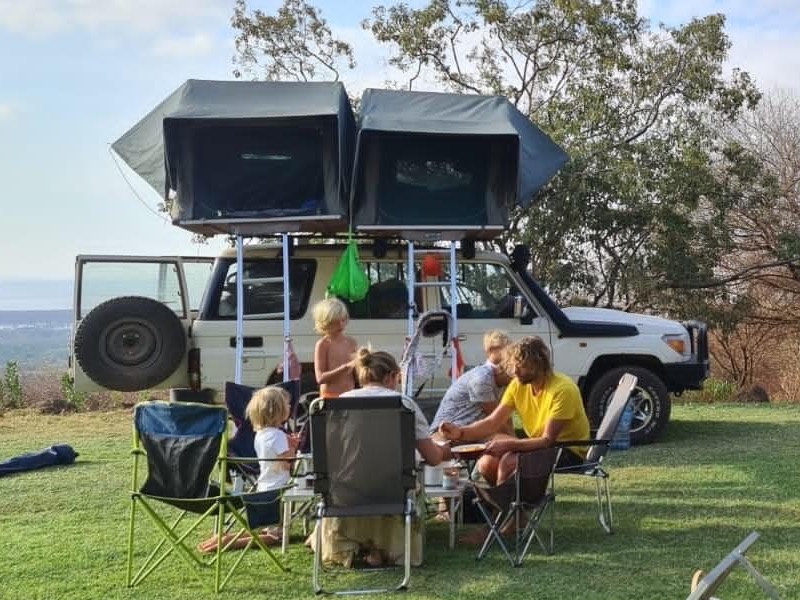
Couples usually need only one rooftop tent.
A single tent keeps the vehicle setup simpler and reduces roof weight.
Three or four travelers may require two tents.
Double-tent vehicles are especially useful for friends traveling together or families with older children.
Before reserving, ask how many adults can genuinely sleep in each tent.
A marketing description saying “sleeps four” may be technically true but uncomfortable for four large adults.
Ask for the mattress dimensions.
Comfort matters after several nights.
Hard-Shell vs Soft-Shell Rooftop Tents
Hard-shell tents are popular because setup can be very quick.
You release the locks or clips and raise the shell.
They are often aerodynamic and convenient for travelers changing camps frequently.
Soft-shell rooftop tents generally fold out and may provide a larger sleeping footprint.
They can take slightly longer to set up and close.
Neither type is automatically better.
The right choice depends on sleeping space, vehicle configuration, ease of setup and personal preference.
If possible, ask the rental company to demonstrate the tent before departure.
Open it yourself.
Close it yourself.
You do not want the first attempt to happen in the dark after a long safari drive.
Why a Rooftop Tent Can Be Better Than Ground Camping
Speed is one advantage.
Once you become familiar with the equipment, camp setup can be relatively simple.
Your mattress remains inside the tent in many configurations.
You do not need to search the ground for a completely flat tent footprint.
The elevated sleeping position is also comfortable for many travelers.
Ground moisture and ordinary crawling insects are less relevant.
Perhaps most importantly, the tent becomes integrated with the vehicle.
Every time you arrive at a campsite, your sleeping system is already there.
The downside is obvious too.
Once the tent is open, your vehicle effectively becomes part of the campsite.
If you want to drive somewhere at night, you must pack the tent first.
That requires planning.
4×4 Roof-Top Tent Rental Arusha for Serengeti Safaris
The Serengeti is one of the major reasons travelers rent rooftop-tent vehicles in Arusha.
Few road trips feel more adventurous than driving across open Serengeti landscapes and sleeping at an approved campsite within the wider ecosystem.
Yet the Serengeti should not be underestimated.
Distances are large.
Tracks can be corrugated and dusty during dry periods.
Rain can transform road conditions.
Navigation becomes more important as you leave major areas.
Fuel planning matters.
For first-time self-drivers, a good route is much more important than simply entering the park and “seeing where the road goes.”
Know where you plan to camp before setting off each morning.
Carry offline navigation.
Ask for current track conditions.
Never depend entirely on mobile data.
Great Migration Self-Drive Safari
Travelers often dream of following the Great Wildebeest Migration with their own vehicle.
The concept is attractive.
The reality requires flexibility.
The migration is a natural wildlife movement rather than a fixed daily schedule.
Rainfall and grazing conditions influence where the herds concentrate.
A route that worked perfectly during the same week last year may not produce identical wildlife conditions this year.
If migration viewing is your main priority, obtain current information before departure.
Plan the broad route, but keep reasonable flexibility.
Remember that campsite availability can limit last-minute changes during peak periods.
4×4 Roof-Top Tent Rental Arusha for Tarangire
Tarangire is an excellent first park for a Northern Circuit road trip.
It is easier to reach from Arusha than the Serengeti and provides an immediate transition into classic safari landscapes.
The park is famous for elephants and enormous baobab trees.
Its relative accessibility makes it useful for travelers who want to familiarize themselves with their vehicle before entering more remote areas.
You can leave Arusha after stocking supplies and reach the wider Tarangire region the same day.
For first-time rooftop campers, this creates a sensible beginning.
You learn how the vehicle handles.
You practice setting up your tent.
You discover whether the cooking equipment is complete.
Any problems emerge before you travel deep into the Serengeti.
Lake Manyara with a Rooftop Tent 4×4
Lake Manyara can fit naturally between Tarangire and Ngorongoro.
The region surrounding Mto wa Mbu also gives travelers opportunities to resupply, find accommodation and experience local culture.
A rooftop tent allows you to mix different accommodation styles.
You do not have to camp every night simply because the vehicle has a tent.
Some travelers camp inside or near wildlife destinations, then occasionally book a guesthouse or lodge for a hot shower, laundry and a break from camp cooking.
That hybrid approach can make a two- or three-week road trip much more comfortable.
Ngorongoro Road Trip Planning
Ngorongoro requires careful budgeting and planning because its fee structure differs from an ordinary national park.
The conservation area is managed separately from Tanzania’s TANAPA national park system, and additional fees can apply depending on the activity and route.
Do not assume your Serengeti park payment automatically covers Ngorongoro.
Confirm the current official requirements before travel.
Crater access, vehicle charges and camping arrangements should be planned specifically.
The highlands can also become cold, especially at night.
Travelers sleeping in rooftop tents around higher elevations should carry warm clothing and appropriate bedding.
Northern Tanzania may be associated with sunshine, but high-altitude nights can surprise unprepared campers.
Arusha National Park Self-Drive Adventure
Arusha National Park is often overlooked by travelers rushing toward Serengeti.
That can make it useful at the beginning of a self-drive journey.
Its proximity to Arusha gives travelers an opportunity to test the vehicle and become comfortable driving in Tanzania before committing to longer distances.
The park also presents very different scenery from the Serengeti.
Mount Meru dominates much of the landscape, while forests, lakes and highland environments create diverse habitats.
For travelers collecting a vehicle early in the morning, Arusha National Park can form part of an easy first day.
Camping Inside Tanzania’s National Parks
Camping inside or near Tanzania’s protected areas can be one of the highlights of a rooftop-tent safari.
However, campsites vary substantially.
Public campsites tend to offer shared facilities and are generally the more affordable choice.
Facilities may be basic.
Do not expect luxury campground infrastructure.
Special campsites provide a different experience and normally require advance arrangements.
Private campsites outside national parks can provide additional amenities such as showers, electricity, restaurants or swimming pools depending on the property.
A smart itinerary combines campsite types.
Use wilderness camps for immersion.
Use better-equipped private camps occasionally to recharge equipment, wash clothes and restock.
Do You Need to Reserve Campsites in Advance?
For major parks and popular seasons, advance planning is wise.
Do not assume you can arrive everywhere at sunset and find an available place to camp.
Some protected-area campsites need formal reservation and payment procedures.
During high-demand travel periods, limited spaces can fill.
Even when reservations are flexible, knowing your planned overnight destination improves safety.
You can calculate realistic drive times.
You avoid unnecessary driving after dark.
You know how much fuel and water you need.
Freedom on a self-drive safari is valuable, but complete improvisation is not always smart.
Camping Fees and Park Fees
One common budgeting mistake is assuming the rental vehicle and campsite are the majority of safari costs.
Government conservation fees can form a significant part of the budget.
National park entrance charges are generally separate from camping fees.
Vehicle fees may also apply.
Ngorongoro has its own authority and pricing framework.
Official tariffs can change.
Taxes and VAT treatment can also make published prices confusing.
For that reason, verify current fees directly before your trip rather than building a large safari budget around an old blog post.
When asking a rental or safari company for advice, request a clear separation between car rental, camping, park fees and other government charges.
Fuel Costs on a Tanzania Self-Drive Safari
Fuel can become one of the largest variable expenses after rental and park charges.
A large Land Cruiser uses considerably more fuel than a compact SUV.
Rough tracks, low-range driving, long game drives and heavy camping loads can increase consumption.
You should therefore estimate fuel based on the actual vehicle rather than generic online assumptions.
Ask the rental company for realistic consumption figures.
Then add a safety margin.
Refuel whenever sensible.
Do not wait until the tank is almost empty in remote regions.
Fuel availability near tourist centers is usually manageable, but distances in Tanzania are significant.
A well-planned road trip treats fuel as a route constraint, not an afterthought.
How Much Does a 4×4 Camping Safari from Arusha Really Cost?
Your rental rate is only the beginning.
A realistic budget should include the vehicle, rooftop tent and camping equipment.
Add fuel.
Then add national park and conservation fees.
Include campsite charges.
Budget for food and drinking water.
Consider insurance excess-reduction options.
Allow money for occasional lodge nights if desired.
Add airport delivery or one-way charges where applicable.
Border documentation matters for cross-border trips.
Activities such as guided walks, cultural experiences and special excursions may cost extra.
Once everything is included, rooftop camping is not necessarily a “cheap safari.”
It can be less expensive than staying every night in premium lodges, especially for two or more travelers.
But its main value is independence.
Insurance for 4×4 Rental in Arusha
Insurance deserves more attention than most travelers give it.
Do not simply ask whether the vehicle is insured.
Ask what the insurance actually covers.
Find out the excess or deductible amount.
Ask whether tire damage is covered.
Ask about windscreen damage.
Ask whether damage to the roof and rooftop tent is covered.
Clarify water damage.
Ask whether underbody damage is excluded.
Find out what happens if you drive on a prohibited road.
Understand theft conditions.
Know whether there are geographical restrictions.
If cross-border travel is planned, confirm insurance validity outside Tanzania.
Read the rental agreement before taking the vehicle.
Security Deposit
Many rental companies require a refundable security deposit.
The amount varies.
Understand how the deposit is collected and returned.
Ask what circumstances allow deductions.
Inspect the vehicle carefully before accepting it.
Take photographs and video.
Record existing body scratches, windscreen chips, wheel damage and interior defects.
Do the same for camping equipment.
This protects both you and the rental company.
A proper handover inspection should never feel rushed.
What to Check Before Driving Away
Your pre-rental handover is one of the most important parts of the journey.
Start with the tires.
Look at tread condition.
Check the spare tire and understand how to remove it.
Confirm the jack and wheel tools are present.
Ask how the four-wheel-drive system works.
Some vehicles use different engagement procedures.
Do not wait until you are stuck in mud to learn.
Test lights and indicators.
Check windshield wipers.
Test the refrigerator or cool box.
Open the rooftop tent completely.
Inspect the mattress.
Count chairs.
Check the table.
Look through the cookware.
Test the gas stove.
Confirm water containers.
Inspect recovery equipment.
You should leave Arusha knowing how every major item works.
Why Two Spare Tires Can Matter
Punctures are not unusual on rough safari roads.
A sharp stone or damaged track can destroy a tire far from the nearest workshop.
One spare is essential.
For longer and more remote journeys, two usable spares can provide additional security.
Ask your rental company what they recommend for your route.
Also ask whether puncture repair equipment is included.
Knowing how to change a tire is useful.
If you have never done it before, ask for a demonstration during vehicle handover.
Recovery Gear for Tanzania Safari Roads
A safari-ready vehicle may carry a jack, tow rope, shovel and traction equipment.
The exact kit varies.
Recovery gear is useful only when you know how to use it.
Do not attempt dangerous vehicle recovery without appropriate knowledge.
A heavy Land Cruiser can cause serious injury when improperly jacked or towed.
The best strategy is prevention.
Avoid clearly impassable tracks.
Do not enter deep water without knowing depth and ground conditions.
Ask other drivers about difficult roads.
Travel cautiously during heavy rain.
Four-wheel drive improves capability, but it does not make a vehicle unstoppable.
Navigation on a Tanzania Self-Drive Safari
Carry more than one navigation method.
Offline GPS mapping is extremely valuable.
Download maps before leaving reliable internet coverage.
Have a physical park map where practical.
Ask campsites and rental staff about current road conditions.
Mobile phone coverage is inconsistent in remote safari areas.
Do not build your navigation system around constant internet access.
Mark important fuel stations and overnight stops before departure.
Know where you are going each morning.
A self-drive safari becomes much less stressful when the navigation has been prepared in advance.
Driving After Dark
Avoid unnecessary night driving.
Wildlife can appear on roads unexpectedly.
Road markings may be limited.
Potholes and livestock become harder to see.
Inside protected areas, movement may also be restricted by operating rules.
Plan each day so you arrive at your destination with daylight remaining.
That gives you time to locate the campsite, set up your rooftop tent and cook before dark.
A common rookie mistake is underestimating Tanzania distances and arriving much later than expected.
Do not calculate road-trip times using European or North American highway speeds.
Safari roads demand slower driving.
Rainy-Season Driving in Tanzania
Rain changes everything.
A track that was straightforward yesterday can become slippery today.
Mud can collect in low-lying areas.
Water crossings become more difficult.
Visibility may decrease.
The wet season is not automatically a reason to avoid self-drive travel, but drivers should be realistic about their experience.
If you have never driven a heavy four-wheel-drive vehicle in mud, a remote Tanzania safari is not the ideal place to learn through trial and error.
Ask for road updates.
Use four-wheel drive appropriately.
Avoid unnecessary risks.
If conditions appear unsafe, change the route.
An extra night at a campsite costs less than a major recovery operation.
Dry-Season Driving
Dry-season tracks are generally easier, but they bring different challenges.
Dust can be intense.
Corrugations make roads uncomfortable and can damage vehicles when driven too fast.
Visibility can deteriorate behind other vehicles.
Tires and suspension take significant punishment.
Drive at a sensible speed.
Slow down when another vehicle approaches.
Keep enough following distance to see beyond the dust cloud.
Check tires regularly.
A dry road is not automatically an easy road.
Best Time for a Rooftop Tent Safari from Arusha
The best time depends on what you want to see and how much driving difficulty you are prepared to handle.
Drier months are popular because road conditions are often more predictable.
Wildlife can also concentrate around water sources in many areas.
The green season provides beautiful landscapes and fewer visitors in some places.
Rain can produce spectacular photography.
However, some tracks become more demanding.
Rental demand and pricing can change with the seasons.
Campsite demand changes as well.
There is no single perfect month.
Choose according to wildlife interests, budget, weather tolerance and driving confidence.
Great Migration Seasons and Rooftop Camping
Many travelers organize their trip around the wildebeest migration.
Remember that the migration covers a huge ecosystem.
Different months can find concentrations in different areas.
Calving typically draws attention toward the southern Serengeti ecosystem early in the year.
Later movements gradually shift northward.
River crossing periods attract intense interest farther north, although exact timing varies.
Do not design your entire route around a single predicted date.
Nature does not keep reservations.
Use recent wildlife information and remain flexible where your campsite bookings allow.
How Many Days Do You Need?
A very short rental rarely allows the rooftop camping concept to shine.
Three or four days can introduce you to one or two nearby destinations.
Seven days creates a much more satisfying Northern Circuit trip.
Ten to fourteen days allows slower exploration.
Three weeks gives adventurous travelers space to combine wildlife parks, cultural stops and less-visited regions.
Longer rentals may also receive lower daily pricing.
Do not try to visit every famous national park in five days.
You will spend much of the trip driving.
A strong self-drive itinerary has time for wildlife viewing and camp life, not just road distance.
Suggested 7-Day Rooftop Tent Safari from Arusha
Begin with vehicle collection and a thorough handover in Arusha.
Use the first day to shop for supplies and travel toward Tarangire or stay near Arusha depending on pickup time.
Spend the following day exploring Tarangire.
Continue toward Lake Manyara or the Mto wa Mbu region.
Then travel into the Ngorongoro highlands.
After Ngorongoro, continue toward the Serengeti.
Spend more than one night there whenever possible.
Return toward Arusha using a route appropriate to your permits and campsite schedule.
Seven days is still relatively fast, but it creates a classic introduction to Northern Tanzania.
Suggested 10-Day Arusha Self-Drive Safari
Ten days allows better pacing.
Start with Tarangire.
Spend two nights where appropriate instead of constantly packing camp.
Continue toward Lake Manyara and Ngorongoro.
Give the Serengeti several nights.
Different Serengeti regions reward slower exploration.
Avoid spending every day changing camps.
A rest day or two-night stay also gives you time to reorganize food, charge devices and enjoy your surroundings.
Return toward Arusha with enough spare time to handle delays.
Never plan to return the vehicle only minutes before an international flight.
Suggested 14-Day Tanzania Rooftop Tent Road Trip
Two weeks creates far more freedom.
You can explore the Northern Circuit without rushing.
Add cultural experiences.
Stay outside parks occasionally.
Spend additional nights in the Serengeti.
Include Arusha National Park at the beginning or end.
Travelers who enjoy photography can stay longer in productive wildlife areas.
You may also combine camping with several lodge nights.
A fourteen-day trip lets you experience the road-trip lifestyle instead of simply completing a checklist.
4×4 Roof-Top Tent Rental Arusha for Couples
Two people are the ideal group size for many rooftop camping configurations.
One tent is enough.
Luggage fits more easily.
Camp setup is quick.
Vehicle rental and fuel are divided between two travelers.
Couples can also share driving where both people are listed and authorized on the rental agreement.
A Land Cruiser may provide more space than necessary, but the comfort and capability can be valuable on longer journeys.
A smaller four-wheel drive may suit shorter or easier routes.
The right choice depends on your itinerary rather than group size alone.
4×4 Roof-Top Tent Rental Arusha for Families
Families require more careful vehicle selection.
First, consider sleeping arrangements.
Two adults and two older children will probably need two rooftop tents or a larger family configuration.
Luggage space becomes important.
Water and food requirements increase.
A refrigerator becomes more valuable.
Driving days should be shorter.
Children may find repeated six-hour road journeys exhausting.
Campgrounds with better facilities can be strategically included.
A family self-drive safari can be unforgettable, but it requires more planning than a couples’ road trip.
Rooftop Tent Rental for Photographers
Photographers often love self-drive freedom.
You can devote more time to landscapes and roadside subjects outside restricted areas.
You control your morning departure from camp.
Your equipment remains close.
However, rooftop camping creates additional considerations.
Dust is a major issue.
Use protective camera bags.
Do not leave equipment loose inside the vehicle.
Heavy lenses must be secured before driving over corrugated tracks.
Electricity planning matters too.
Bring suitable charging systems.
Ask whether the vehicle has USB sockets, inverters or a secondary battery setup.
Food for a Tanzania Self-Drive Camping Safari
Food planning can be simple.
Do not try to cook elaborate restaurant meals every night.
Choose ingredients that travel well.
Rice, pasta, oats, bread and canned foods are practical.
Fresh vegetables can be purchased periodically.
Eggs are useful when safely stored.
A refrigerator greatly increases options.
Carry enough drinking water.
Have emergency food that does not require cooking.
After a long day of driving, a simple meal can feel much better than spending an hour preparing something complicated.
Shopping in Arusha before departure usually gives you the greatest choice.
Restock when passing towns rather than waiting until supplies are almost finished.
Drinking Water
Never treat water as an afterthought.
Carry enough for drinking, cooking and basic camp needs.
Hot weather can increase consumption significantly.
Vehicle breakdowns can also delay travel.
Always have a reserve.
A rooftop camping vehicle may come with jerry cans or water tanks.
Ask their capacity.
Refill whenever reliable supplies are available.
For longer remote routes, plan water in the same way you plan fuel.
Refrigerator vs Cool Box
A proper 12-volt refrigerator can transform camp life.
Food remains fresh longer.
Cold drinks are available after hot game drives.
You can buy supplies less frequently.
However, a refrigerator needs power.
Ask how the vehicle’s electrical system supports it.
Some vehicles use a second battery.
A cool box is simpler but depends on ice and loses efficiency over time.
For two or three days, a cool box can be enough.
For longer road trips, a fridge is usually worth having.
Electricity and Charging
Phones, cameras, navigation devices and laptops all need power.
Ask about charging options before departure.
USB ports are useful.
A 12-volt socket may allow adapters.
Some vehicles have an inverter.
A dual-battery system helps protect the starting battery while running camping accessories.
Do not assume you can charge everything at campsites.
Remote sites may have limited or no electricity.
Carry power banks.
Keep essential navigation devices charged.
Toilets and Showers at Campsites
Facilities vary from basic to comfortable.
Some public campsites provide shared toilets and showers.
Others are considerably more rustic.
Private campsites outside protected areas may provide better bathrooms, hot showers, restaurants and electricity.
Research each planned stop.
Travelers expecting European campground standards can be surprised by remote safari camps.
That simplicity is part of the experience.
If you want occasional comfort, book a private campsite or lodge every few nights.
Wildlife Safety at Campsites
Camping near African wildlife is exciting because the environment remains wild.
That also means campers must behave responsibly.
Never store food carelessly.
Follow campsite instructions.
Do not walk away from camp at night without understanding local procedures.
Use a torch.
Keep children close.
Do not approach animals.
Never feed wildlife.
If park or campsite staff provide specific advice, follow it.
Your rooftop tent does not turn a wildlife area into an ordinary campground.
You are still a visitor in an ecosystem inhabited by large animals.
Can Animals Reach a Rooftop Tent?
A rooftop tent elevates your sleeping position, but it should never create false confidence.
Wild animals can move through campsites.
Elephants, hyenas and other species may occasionally pass near camping areas.
The correct safety strategy is not relying on the tent’s height.
It is following campsite rules, storing food properly and behaving appropriately around wildlife.
Do not climb down at night simply because you hear an interesting sound outside.
Use common sense and follow local guidance.
Self-Drive vs Driver-Guide Rooftop Camping Safari
Travelers sometimes want the camping experience without taking responsibility for navigation and driving.
A 4×4 with a driver-guide and rooftop tents can provide that combination.
You still camp.
You still travel overland.
But a local professional handles driving, routes and much of the safari navigation.
This is particularly useful for first-time visitors who are nervous about the Serengeti’s road network.
A driver-guide also improves wildlife interpretation.
Self-driving offers maximum independence.
A guided vehicle offers local knowledge.
Neither is automatically superior.
Choose according to experience and priorities.
First-Time Self-Drive Safari: Is Tanzania the Right Choice?
Experienced road trippers may adapt quickly.
Drivers who have handled four-wheel-drive vehicles on gravel, mud and rough roads will feel more comfortable.
First-time African drivers should be realistic.
Traffic patterns, road conditions, wildlife and navigation may all be unfamiliar.
You can still enjoy a self-drive trip.
Just begin conservatively.
Spend time around Arusha.
Choose easier routes first.
Avoid overly ambitious distances.
Consider hiring a driver-guide for difficult sections.
The goal is adventure, not proving something.
One-Way 4×4 Rental from Arusha
One-way rental can make longer itineraries much more efficient.
You might collect the vehicle in Arusha and return it elsewhere in Tanzania.
Some companies also arrange international one-way rentals.
These services normally attract repositioning charges.
The cost depends on distance and logistics.
Ask for the total one-way fee before booking.
Also confirm who is responsible for retrieving the vehicle.
A low advertised daily rate can become expensive when a large repositioning charge is added later.
Arusha to Dar es Salaam One-Way Rental
Travelers combining Northern Tanzania with the coast may consider driving from Arusha toward Dar es Salaam.
This creates a much longer road trip and allows exploration beyond the standard Northern Circuit.
However, simply using a safari Land Cruiser as a transfer vehicle may not always be economical.
Calculate fuel, rental days and one-way charges.
Sometimes a flight followed by another rental makes more financial sense.
Sometimes the road journey itself is the objective.
Decide what kind of trip you want before choosing the transport.
Arusha to Kenya with a Rooftop Tent
Cross-border travel into Kenya can be attractive for overlanders.
A route can potentially combine Tanzania’s Northern Circuit with Amboseli, Nairobi, the Rift Valley or Maasai Mara.
However, never assume your Tanzania rental can simply cross the border.
You need written authorization from the rental company.
Insurance must remain valid.
Vehicle documents must be correct.
Cross-border charges may apply.
Entry requirements for both travelers and vehicles must be confirmed.
Organize this before departure, not at the border.
Arusha to Rwanda and Uganda Road Trips
Long-term travelers may want to continue toward Rwanda or Uganda.
A multi-country East African road trip can be extraordinary.
Distances are significant, so this is more suitable for travelers with several weeks available.
Cross-border permissions become essential.
Insurance, road taxes and vehicle documentation must be arranged correctly.
One-way returns may be complicated and expensive.
A round-trip route might make more sense.
Ask the rental company for experience with the specific countries you intend to visit.
What to Ask Before Booking a 4×4 Roof-Top Tent Rental Arusha
The daily price should be only the beginning of your conversation.
Ask exactly which vehicle you will receive.
Find out whether the quoted vehicle type is guaranteed or merely “or similar.”
Ask its transmission type.
Confirm whether air conditioning works.
Ask how many spare tires are supplied.
Request the camping equipment inventory.
Ask about unlimited mileage.
Clarify insurance.
Understand the excess.
Ask about roadside assistance.
Confirm what happens after a mechanical breakdown.
Ask about after-hours contact.
Check cross-border rules if relevant.
Confirm airport delivery costs.
Ask about security deposits.
The quality of the answers often reveals the quality of the rental company.
Vehicle Age and Maintenance
Age alone does not determine reliability.
A well-maintained older Land Cruiser can be more dependable than a poorly maintained newer SUV.
Ask how vehicles are serviced.
Look at tire condition.
Listen for strange noises during the test drive.
Check warning lights.
Observe fluid leaks.
Test brakes.
If something feels wrong during handover, address it immediately.
Do not accept “it always does that” as the only explanation for a serious mechanical concern.
A safari rental should be properly prepared before you leave.
Roadside Assistance
Understand how assistance actually works.
“24-hour support” can mean very different things.
Is there a phone number answered overnight?
What happens if there is no mobile signal?
Does the company have mechanics outside Arusha?
How is a replacement vehicle arranged after a major failure?
Who pays for recovery if the breakdown is caused by normal mechanical failure?
Who pays if the driver damages the vehicle?
Get clarity before the trip.
The best roadside assistance is the service you never need, but its quality matters enormously if something goes wrong.
Unlimited Mileage
Unlimited mileage sounds attractive, especially for Tanzania.
Confirm whether it is genuinely unlimited.
Some rental agreements restrict the areas in which the vehicle may travel.
Others prohibit certain roads.
There may also be limits on driving after dark.
A rental described as unlimited mileage does not necessarily mean unlimited freedom.
Read the contract.
Manual vs Automatic 4×4
Choose the transmission you can drive confidently.
A manual vehicle may provide excellent control, but that advantage disappears if the driver is uncomfortable using it.
An automatic Land Cruiser can be much easier for travelers adapting to unfamiliar roads.
Remember that Tanzania drives on the left.
Drivers coming from right-hand-traffic countries already have an adjustment to make.
Adding an unfamiliar manual gearbox can increase stress.
Comfort and confidence matter more than proving you can drive a particular vehicle type.
Driving Side in Tanzania
Tanzania drives on the left side of the road.
Vehicles are generally right-hand drive.
Travelers from the United Kingdom, Australia, South Africa and similar countries will find this familiar.
Visitors from continental Europe, the United States, Canada and many other countries need to adjust.
Take the first day slowly.
Be particularly careful at intersections and when turning.
The greatest mistakes often happen on quiet roads when drivers revert automatically to habits from home.
International Driving Permit
Driving-document requirements should be checked before travel because regulations and rental policies can change.
Bring your valid domestic driving license.
Ask the rental company whether an International Driving Permit is required or recommended for your nationality and rental.
Do not leave this question until arrival.
An International Driving Permit cannot always be obtained instantly after you have already left your home country.
Speed on Safari Roads
Fast driving damages vehicles and reduces wildlife enjoyment.
Corrugated tracks can tempt drivers to increase speed because certain frequencies feel smoother.
That can reduce control and increase suspension stress.
Drive conservatively.
Slow down around people, livestock and wildlife.
Respect official park limits.
You are on holiday.
There is no prize for reaching camp first.
What Happens If the 4×4 Breaks Down?
First, stay calm.
Move the vehicle to a safe location when possible.
Contact the rental company’s emergency support.
Provide your position using GPS coordinates where available.
Do not authorize major mechanical repairs without communicating with the rental provider unless immediate safety requires action.
Understand your contract’s breakdown procedures before departure.
Keep water, food and essential medication accessible even on ordinary driving days.
A mechanical delay becomes much easier when you are prepared.
Common Mistakes When Renting a Rooftop Tent 4×4 in Arusha
The first mistake is choosing solely on price.
The second is failing to inspect the vehicle.
The third is attempting too much distance.
Another common mistake is packing too much.
Heavy luggage reduces vehicle space and makes camp organization harder.
Travelers also underestimate fuel costs.
Some do not reserve campsites.
Others assume mobile internet will handle navigation everywhere.
A particularly serious mistake is ignoring rental restrictions.
Taking a vehicle onto a prohibited road can invalidate parts of your insurance.
Read the agreement.
Packing for a Rooftop Tent Safari
Pack soft bags rather than enormous hard suitcases when possible.
Soft luggage is easier to organize inside a camping vehicle.
Bring layers of clothing.
Days can be hot while highland nights become surprisingly cool.
Carry a lightweight waterproof jacket.
Bring sturdy shoes.
Use a headlamp rather than relying only on a handheld torch.
Carry insect repellent and sunscreen.
Pack personal medication.
Bring reusable water bottles.
A small first-aid kit is useful even when the vehicle has one.
Avoid filling every corner of the car.
Space becomes part of your comfort.
Clothing for Camping in Northern Tanzania
Safari clothing does not need to be complicated.
Comfort is more important than fashion.
Lightweight trousers and shirts work well during the day.
A fleece or warm jacket is valuable around Ngorongoro and during cool mornings.
Bring a hat.
Use closed shoes around camp.
Sandals can be useful at private campsites.
Neutral clothing is practical but you do not need an entirely khaki wardrobe.
Bring clothing you can wash and reuse.
Long road trips reward simplicity.
Mosquitoes and Insects
Insects are a natural part of outdoor travel.
Keep the rooftop tent screens closed properly.
Do not leave the tent open unnecessarily with lights on.
Use suitable insect repellent.
Follow appropriate travel-health advice for Tanzania before departure.
Different destinations and seasons can have different mosquito levels.
Medical prevention decisions should be based on professional guidance rather than travel-blog anecdotes.
Travel Insurance
Good travel insurance is strongly recommended.
Your policy should be suitable for your itinerary.
Self-drive travel, camping and cross-border journeys may introduce conditions that are not covered by every basic policy.
Read exclusions.
Check medical evacuation coverage.
Understand rental-car protection versus the rental company’s own insurance.
They are not always the same.
Keep emergency information available offline.
Can a Rooftop Tent Safari Save Money?
Potentially, yes.
Accommodation is integrated with the vehicle.
Cooking some meals reduces restaurant spending.
Longer rentals may receive discounted daily rates.
For two or more travelers, costs are shared.
However, Tanzania’s park fees remain significant regardless of whether you camp or stay in luxury accommodation.
Fuel costs also remain.
This means rooftop camping should not be chosen only because you expect an extremely cheap safari.
Choose it because you want the experience and independence.
Any savings are a bonus.
Rooftop Camping vs Lodge Safari
A lodge safari provides comfort.
Your room is ready when you arrive.
Meals are prepared.
Someone else handles most logistics.
You may have swimming pools, bars and comfortable lounges.
Rooftop camping gives you independence.
You build your own camp.
You cook or arrange meals.
You wake up inside the outdoor environment.
There is more work but also more involvement.
Many travelers combine both.
Camp for several nights, then spend a night in a lodge.
That combination provides adventure without turning the entire holiday into constant camp chores.
Self-Drive vs Organized Safari
An organized safari gives you a professional guide who understands animal behavior, park geography and local conditions.
This can significantly improve wildlife viewing.
Self-drive provides freedom and privacy.
You choose your own pace.
The best choice depends on priorities.
First-time safari visitors whose main objective is finding wildlife may benefit greatly from a guide.
Experienced Africa travelers may prefer self-drive.
Some travelers rent a rooftop-tent vehicle but hire a local guide for selected destinations.
That hybrid approach can provide the best of both worlds.
Is a 4×4 Roof-Top Tent Rental Arusha Worth It?
For the right traveler, absolutely.
Few holidays provide the same sense of freedom.
You begin the morning by climbing down from your tent.
You make coffee beside your safari vehicle.
You look at the map and decide how the day will unfold.
Hours later, you may be watching elephants beneath baobab trees or driving across the Serengeti.
Then you return to camp, prepare dinner and listen to the sounds of the African night.
That experience cannot be replicated by simply moving between hotels.
But it requires preparation.
The adventure is rewarding precisely because you participate in it rather than having every detail handled for you.
How to Choose the Best 4×4 Roof-Top Tent Rental Arusha
Begin with your route.
Decide which parks you want to visit.
Estimate the number of days.
Consider the season.
Then choose a vehicle capable of handling that route.
Request several quotations.
Compare what is included rather than comparing daily rate alone.
Review the insurance excess.
Check camping equipment.
Ask about tires and recovery gear.
Understand roadside assistance.
Read reviews where available.
Make sure communication is responsive before paying.
If a rental company struggles to answer simple questions before receiving your money, do not expect communication to improve after you are hundreds of kilometers from Arusha.
Booking Early for Peak Season
Popular vehicles are limited.
A reliable Land Cruiser fitted with one or two rooftop tents cannot be created instantly when demand increases.
Peak safari months can therefore reduce availability.
Travelers with fixed dates should reserve early.
This is especially important if you need an automatic vehicle, double rooftop tents or cross-border documentation.
Early booking also gives you more time to plan campsites and park reservations.
Last-Minute Rooftop Tent Rental in Arusha
Last-minute rentals are sometimes available.
You may even find attractive prices when a company has an unused vehicle.
However, vehicle choice will be narrower.
Do not accept an unsuitable vehicle merely because it is available.
Inspect it carefully.
Verify insurance and equipment.
Your safari is still taking place in demanding environments even when the reservation was made yesterday.
4×4 Roof-Top Tent Rental Arusha FAQs
How much does a rooftop tent 4×4 cost in Arusha?
Rates vary by vehicle, season and rental length. Fully equipped rooftop-tent 4×4 rentals often fall broadly around US$120–US$200+ per day, while premium Land Cruisers and multi-tent setups can cost more.
What is the best vehicle for a Tanzania self-drive safari?
A Toyota Land Cruiser is among the most popular choices for serious Northern Circuit routes because of its durability, clearance and off-road capability.
Can I rent a 4×4 with a rooftop tent in Arusha?
Yes. Several Arusha rental companies provide 4×4 vehicles equipped with single, double or family rooftop-tent configurations.
Can I drive from Arusha to Serengeti myself?
Independent road travel is possible in various contexts, but park access requirements and operating rules must be checked for your specific route. Confirm the latest rules with the relevant park authority and rental company before travel.
Do I need a 4×4 for Serengeti?
A proper high-clearance four-wheel-drive safari vehicle is the sensible choice for extensive travel on Serengeti’s unpaved roads.
What equipment comes with a rooftop tent rental?
Packages vary but can include a rooftop tent, mattress, bedding, chairs, table, stove, gas cylinder, cookware, water containers, refrigerator or cool box, tools and recovery gear.
Can four people sleep in rooftop tents?
Yes, when the vehicle has two rooftop tents or an appropriate family setup.
Are campsite fees included in the vehicle rental?
Usually not unless specifically stated. Vehicle rental, park fees and campsite costs should normally be budgeted separately.
Are Tanzania national park fees included?
Normally no. Confirm the rental quotation because government park fees are generally separate.
Is fuel included?
Vehicle rentals usually do not include the fuel consumed during your safari.
Can I collect the vehicle at Kilimanjaro International Airport?
Many Arusha rental companies offer airport collection or vehicle delivery, sometimes for an additional fee.
Can I return the vehicle in another city?
One-way rentals may be available, usually with an additional repositioning charge.
Can I cross into Kenya?
Some rental providers allow cross-border travel with advance written permission and the correct insurance and vehicle documentation.
Can I drive the rental to Rwanda or Uganda?
Some companies offer multi-country rental arrangements. This must be approved and documented before departure.
Is unlimited mileage included?
Some rentals include unlimited mileage while others impose restrictions. Confirm this in writing.
Do rooftop tents have mattresses?
Most purpose-built rooftop-tent rentals include a fitted mattress, but bedding arrangements vary.
Do I need to reserve campsites?
Advance campsite planning is strongly recommended, particularly in major protected areas and peak seasons.
Is a rooftop tent safe around wildlife?
It is designed for camping, but wildlife safety depends primarily on following campsite and park rules. Never treat the tent’s elevation as permission to ignore animal safety.
Can I cook at the campsite?
Designated campsites often permit cooking under their specific rules. Your rental package may provide a gas stove and kitchen equipment.
Is Tanzania good for first-time self-driving?
It can be, provided the traveler is confident, chooses a realistic route and understands local driving and park requirements. First-time visitors can also combine self-driving with a professional driver-guide where useful.
Should I rent a manual or automatic Land Cruiser?
Choose the transmission you are most comfortable driving. Confidence on unfamiliar roads matters more than preference for a particular gearbox.
What happens if the vehicle breaks down?
Contact the rental company’s roadside support and follow its rental-agreement procedures. Understand these procedures before leaving Arusha.
Should I have one or two spare tires?
At least one usable full-size spare is essential. For longer or more remote routes, ask whether two spares are advisable.
Can I camp outside designated campsites?
Do not assume wild camping is permitted. Use approved camping areas and follow park, conservation-area and local regulations.
Is rooftop camping cheaper than lodges?
It can reduce accommodation and meal costs, but rental, fuel and conservation fees remain significant. The greatest advantage is usually freedom rather than simply the lowest possible price.
How long should I rent a rooftop tent 4×4?
Seven to fourteen days provides enough time for a rewarding Northern Circuit road trip. Longer journeys allow considerably slower travel.
Final Advice for Your 4×4 Roof-Top Tent Rental Arusha Adventure
The freedom of a self-drive safari is difficult to beat.
A rooftop-tent vehicle lets you travel, sleep and explore using one carefully equipped 4×4.
Arusha gives you access to some of Africa’s most spectacular landscapes.
Tarangire brings elephants and baobabs.
Ngorongoro provides dramatic highland scenery and extraordinary wildlife.
The Serengeti opens into immense plains where the horizon can feel endless.
But the quality of the journey depends on preparation.
Choose the vehicle according to the route.
Inspect it before departure.
Understand insurance.
Learn to use four-wheel drive.
Check every piece of camping equipment.
Carry adequate food, water and fuel.
Download offline maps.
Reserve essential campsites.
Give yourself realistic driving times.
Avoid unnecessary night driving.
Respect wildlife and protected-area rules.
And do not judge a rental company only by the lowest daily rate.
A well-prepared vehicle and reliable support can be worth far more than a small initial saving.
For independent travelers who enjoy road trips and outdoor living, a 4×4 roof-top tent rental Arusha can transform Tanzania from a conventional safari destination into a genuine overland adventure.
Instead of watching the country through the window of a scheduled tour, you become part of the journey.
You decide when to leave.
You decide where to stop.
You open your tent beneath the African sky.
And the next morning, the road begins again.
Plan Your Tanzania and East Africa Safari with Universal Ventures Rwanda
Travelers looking to combine Tanzania with Rwanda, Uganda or a wider East African journey can contact Universal Ventures Rwanda for tailor-made safari planning, gorilla trekking tours, wildlife safaris, private transportation and multi-country travel arrangements.
Universal Ventures Rwanda specializes in customized East African experiences that can include Rwanda gorilla trekking, Uganda primate safaris, Tanzania wildlife adventures, private transfers and cross-border safari itineraries.
Universal Ventures Rwanda Contact Details
Universal Ventures Rwanda
Address: KN 15 Road, Opposite IPRC Entrance, 1st Floor, SANGWA Plaza, Kigali, Rwanda
Phone / WhatsApp: +250 781 441 853
Email: info@universalventuresrwanda.com
Website: www.universalventuresrwanda.com
